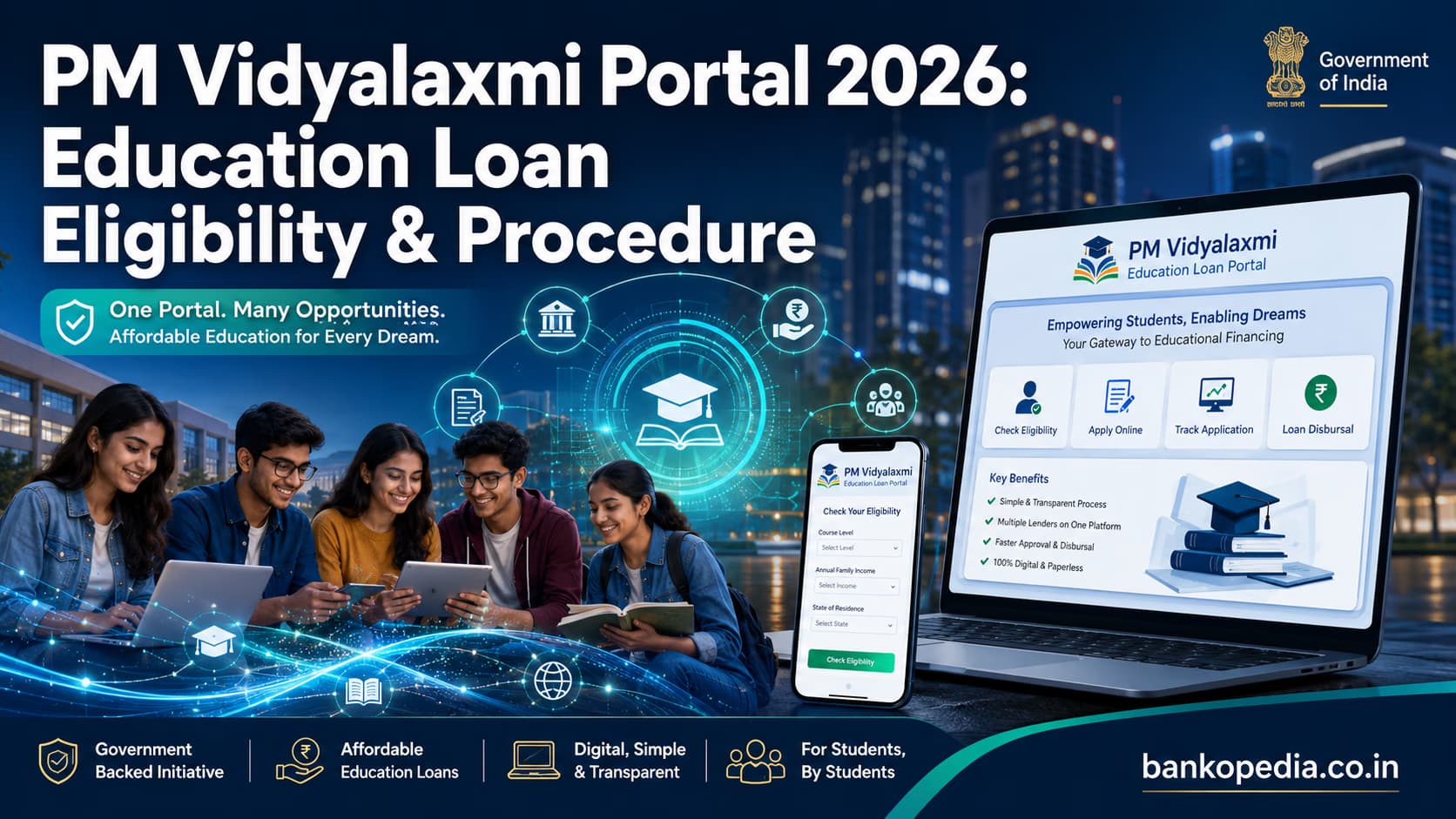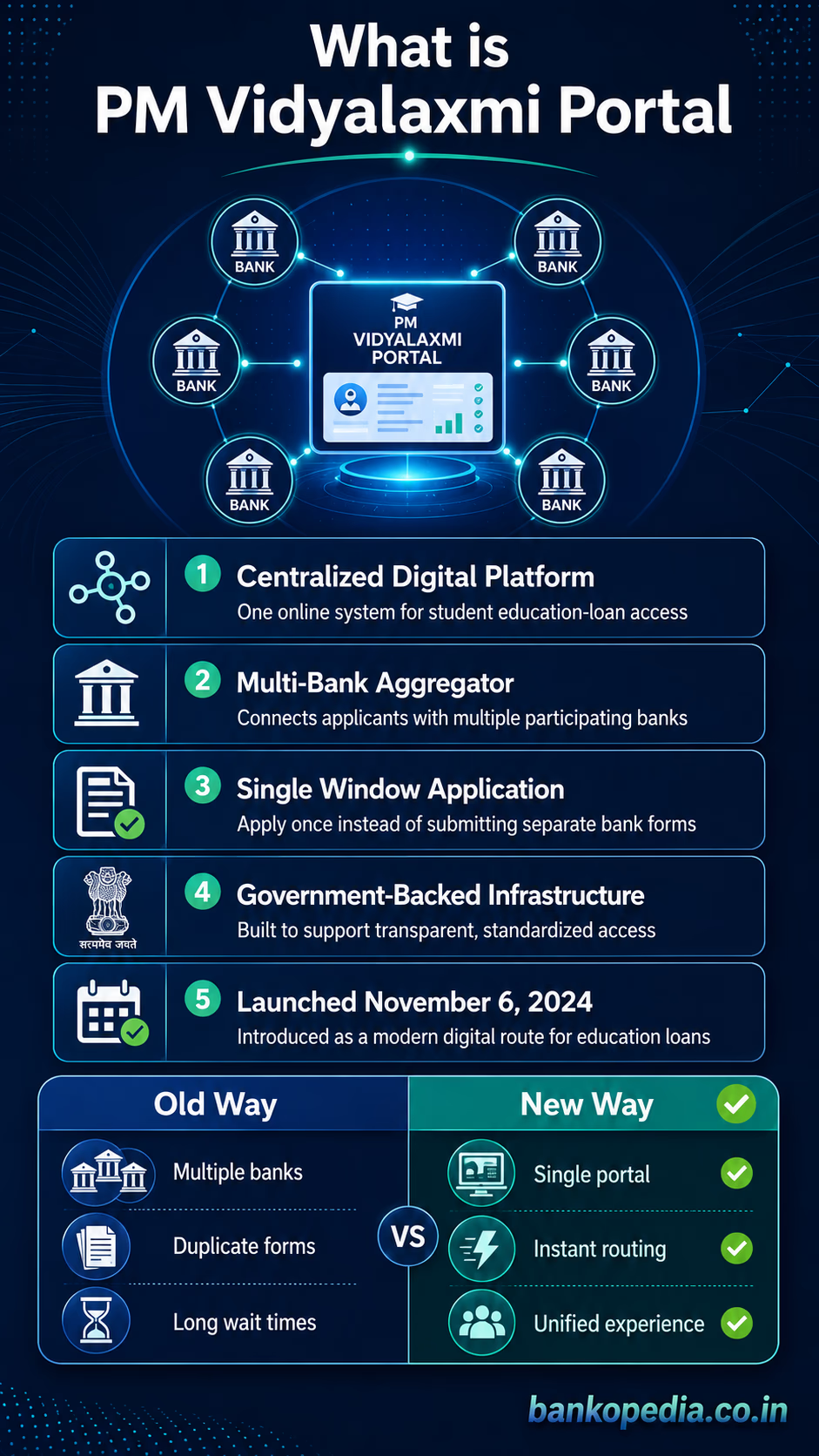
The Union Cabinet formally approved the PM Vidyalaxmi Scheme on 6 November 2024, and all education loans sanctioned after that date fall under its operational framework. This announcement has created widespread nomenclature confusion among students, parents, and even banking professionals, because an older platform called the Vidya Lakshmi Portal already existed. That earlier portal was launched in August 2015 under the administration of NSDL e-Governance Infrastructure Limited (NSDL e-Gov) — a government-promoted entity — following a Union Budget announcement by the then Finance Minister. While the 2015 Vidya Lakshmi Portal was a meaningful first step toward digitising education loan access, it remained limited in scope, with fewer bank integrations and restricted subsidy linkages. The 2024 PM Vidyalaxmi Scheme represents a comprehensive overhaul rather than an incremental update, and the two should not be treated as the same programme.
Understanding where PM Vidyalaxmi fits within India's larger policy architecture helps clarify its significance. The scheme is explicitly anchored to the National Education Policy (NEP) 2020, which set an ambitious target of raising the Gross Enrolment Ratio (GER) — the proportion of eligible youth enrolled in higher education — to 50 percent by 2035, up from approximately 27.1 percent recorded in 2021-22 (Ministry of Education, Annual Report 2022-23). One of the persistent barriers to achieving that target has been the difficulty that economically diverse students face in accessing formal credit for higher education. PM Vidyalaxmi is designed to lower that barrier by making the loan application process faster, more transparent, and institution-agnostic.
The scheme also complements the existing Central Sector Interest Subsidy (CSIS) scheme, which provides full interest subsidy on education loans up to ₹7.5 lakh during the moratorium period — that is, the course duration plus one year after completion — for students from families with an annual income of up to ₹4.5 lakh. Under the expanded PM Vidyalaxmi framework, interest subsidy benefits are extended further up the income ladder, covering a specific partial subvention for families earning between ₹4.5 lakh and ₹8 lakh, which is discussed in detail elsewhere in this article. The two programmes are now intended to work in tandem rather than as parallel, disconnected initiatives.
The nodal authority overseeing PM Vidyalaxmi is the Ministry of Education, specifically its Department of Higher Education, which sets the eligibility criteria, designates qualifying institutions, and monitors scheme outcomes. However, the operationalisation of the banking side — that is, convincing and formally onboarding public sector banks, private sector banks, and select regional rural banks as active lending partners on the portal — falls under the purview of the Department of Financial Services (DFS), which functions under the Ministry of Finance. This dual-ministry governance structure ensures that both the academic quality standards and the financial services delivery standards are independently supervised, reducing the risk of either side being deprioritised. As of the scheme's launch in November 2024, the government had committed to integrating all major scheduled commercial banks, with public sector banks such as State Bank of India, Bank of Baroda, and Punjab National Bank among the first to be onboarded onto the PM Vidyalaxmi Portal.
PM Vidyalaxmi Portal Education Loan 2026: Key Features at a Glance
The PM Vidyalaxmi Portal anchors its benefits to a carefully curated set of approximately 860 Quality Higher Education Institutions, or QHEIs — a term referring to institutions that meet defined academic quality benchmarks set by the government. Specifically, the QHEI list is built using the National Institutional Ranking Framework (NIRF) and encompasses all Higher Education Institutions (HEIs) that appear in the top 100 of any NIRF ranking (overall, category-specific, or domain-specific), State Government HEIs ranked between 101 and 200 in NIRF, and all Central Government institutions. This list covers premier institutions such as the Indian Institutes of Technology (IITs), Indian Institutes of Management (IIMs), and National Institutes of Technology (NITs). By restricting the scheme to these institutions rather than opening it to every college in the country, the government ensures that credit flows toward programmes most likely to generate strong employment outcomes and loan repayment capacity.
One of the most significant financial benefits built into the scheme is a 3% per annum interest subvention — meaning the government pays 3 percentage points of the interest on the student's behalf — on education loans up to ₹10 lakh. This benefit is structured under a strict two-tiered system based on annual family income. Students from families with an annual income of up to ₹4.5 lakh receive full (100%) interest subvention during the moratorium period under the aligned PM-USP Central Sector Interest Subsidy (CSIS) scheme. The specific new benefit introduced by PM Vidyalaxmi bridges the gap for the middle-income segment: families earning between ₹4.5 lakh and ₹8 lakh per annum qualify for the 3% interest subvention on loans up to ₹10 lakh. Crucially, the subvention covers the entire moratorium period, which includes the course duration plus an additional 12 months after graduation, preventing interest from silently compounding into an unmanageable debt burden before the student has even begun earning. Families earning above ₹8 lakh annually do not receive an interest subvention under the PM Vidyalaxmi framework, though they retain full access to the portal's loan-matching and application infrastructure.
Students who cannot offer property or assets as security benefit from a dedicated provision under the Credit Guarantee Fund Scheme for Education Loans, commonly abbreviated as CGFSEL. Under this arrangement, loans up to ₹7.5 lakh are available without any collateral or third-party guarantor. The government-backed guarantee fund provides a 75% credit guarantee on outstanding defaults for these loans, meaning the bank retains a 25% risk exposure on any defaulted amount. This feature is particularly consequential for first-generation learners — students who are the first in their families to pursue higher education — who typically have neither parental assets to pledge nor influential co-signers to offer.
Rather than disbursing interest subvention as cash directly to the student, the scheme operates through an e-voucher mechanism. Under this model, the government electronically credits the subvention amount directly into the student's loan account held with the participating bank. This ring-fencing of funds ensures that the government's financial support is applied exclusively toward reducing the outstanding loan liability and cannot be diverted for other purposes. The approach mirrors similar direct-benefit-transfer frameworks used in other government subsidy programmes and significantly reduces leakage and administrative overhead (Ministry of Education, Government of India, 2024).
In its initial phase, the PM Vidyalaxmi scheme targets an annual outreach of 1 lakh students — approximately 100,000 beneficiaries per year. The budgetary framework has been designed with scalability in mind, meaning the financial allocation can be expanded as more banks join the portal as participating lenders and as institutional coverage potentially broadens beyond the current 860 QHEIs. The government's intent, as outlined during the scheme's announcement, is to use the first few years as a calibration period to assess loan utilisation patterns, repayment rates, and operational bottlenecks before committing to a wider rollout. This phased approach reflects a deliberate policy choice to prioritise programme quality over immediate scale.
Eligibility Criteria: Who Can Apply in 2026?
To access the PM Vidyalaxmi Portal education loan 2026 and its associated interest subvention benefits, applicants must first satisfy a clear nationality condition. The portal is open exclusively to Indian citizens holding a valid Indian passport or government-issued identity proof confirming Indian citizenship. Non-Resident Indians (NRIs) — Indian citizens living and working abroad — and Overseas Citizens of India (OCI) cardholders, who hold a lifelong visa to India but are not full citizens, are explicitly excluded from the central interest subvention component. They may, however, approach individual banks directly for commercial education loans outside the portal framework.
Institutional eligibility forms the second critical filter. A student's admission must be in one of the approximately 860 Quality Higher Education Institutions, or QHEIs — institutions defined using the National Institutional Ranking Framework (NIRF). The QHEI list includes all HEIs in the NIRF top 100 (overall, category, or domain-specific rankings), State Government HEIs ranked 101–200 in NIRF, and all Central Government institutions. Students admitted to private deemed universities, unrecognised institutions, or any college not appearing on the approved QHEI list cannot claim the interest subvention benefit. Importantly, they are not barred from using the portal itself — they may still submit loan applications through the platform, but those loans will be processed at standard commercial interest rates without any government subsidy.
Family income is the primary determinant of how much interest relief a student can receive. The scheme imposes no upper income ceiling for simply accessing the portal or for applying for an education loan. However, the subvention structure operates on a strict two-tiered system: students from families with an annual income of up to ₹4.5 lakh receive full (100%) interest subvention during the moratorium under the aligned PM-USP CSIS scheme. The specific new benefit introduced by PM Vidyalaxmi applies to the ₹4.5 lakh to ₹8 lakh income segment, which qualifies for a 3% interest subvention on loans up to ₹10 lakh — meaning the government absorbs 3 percentage points of the applicable interest rate during the moratorium period (the repayment-free window lasting through the course duration plus one year). Families earning above ₹8 lakh annually receive no subvention benefit under the PM Vidyalaxmi framework, though they retain full access to the portal's loan-matching and application infrastructure and may secure loans at the bank's prevailing market rate.
Course-level eligibility is equally specific. The scheme covers full-time undergraduate, postgraduate, and doctoral programmes in technical fields such as engineering and architecture, professional streams including law and chartered accountancy, medical and allied health sciences, and management disciplines such as MBA programmes. Crucially, part-time courses, correspondence programmes, and distance-learning degrees are generally excluded from eligibility, regardless of whether the institution offering them is a QHEI. The rationale is that the scheme targets students who are fully committed to a structured, residential or campus-based academic pathway and who typically need financial support to sustain themselves through the entire programme duration.
On the question of loan size, applications through the portal typically begin at a minimum ticket size of ₹50,000. The government's interest subvention benefit, however, applies only on the principal loan amount up to ₹10 lakh — any sanctioned amount beyond this threshold is treated as a commercial extension at the bank's own risk and pricing. Participating banks retain the discretion to sanction significantly higher amounts for deserving candidates: loans for overseas education, for instance, can extend up to ₹1.5 crore under the commercial terms of individual lenders such as the State Bank of India, Bank of Baroda, or Union Bank of India, all of which are active on the portal. In such cases, only the first ₹10 lakh of the loan principal would attract the subvention, while the remainder is priced at the bank's standard education loan rate.
Documents Required Before You Start the Application
Gathering the right documents before logging into the PM Vidyalaxmi Portal education loan 2026 application can save considerable time and prevent mid-process delays. The portal follows a digital-first workflow, which means most documents must be uploaded as scanned copies in prescribed file formats — typically PDF or JPEG — within defined size limits. Having every paper ready in advance reduces the risk of your application being returned incomplete by the participating bank's processing team.
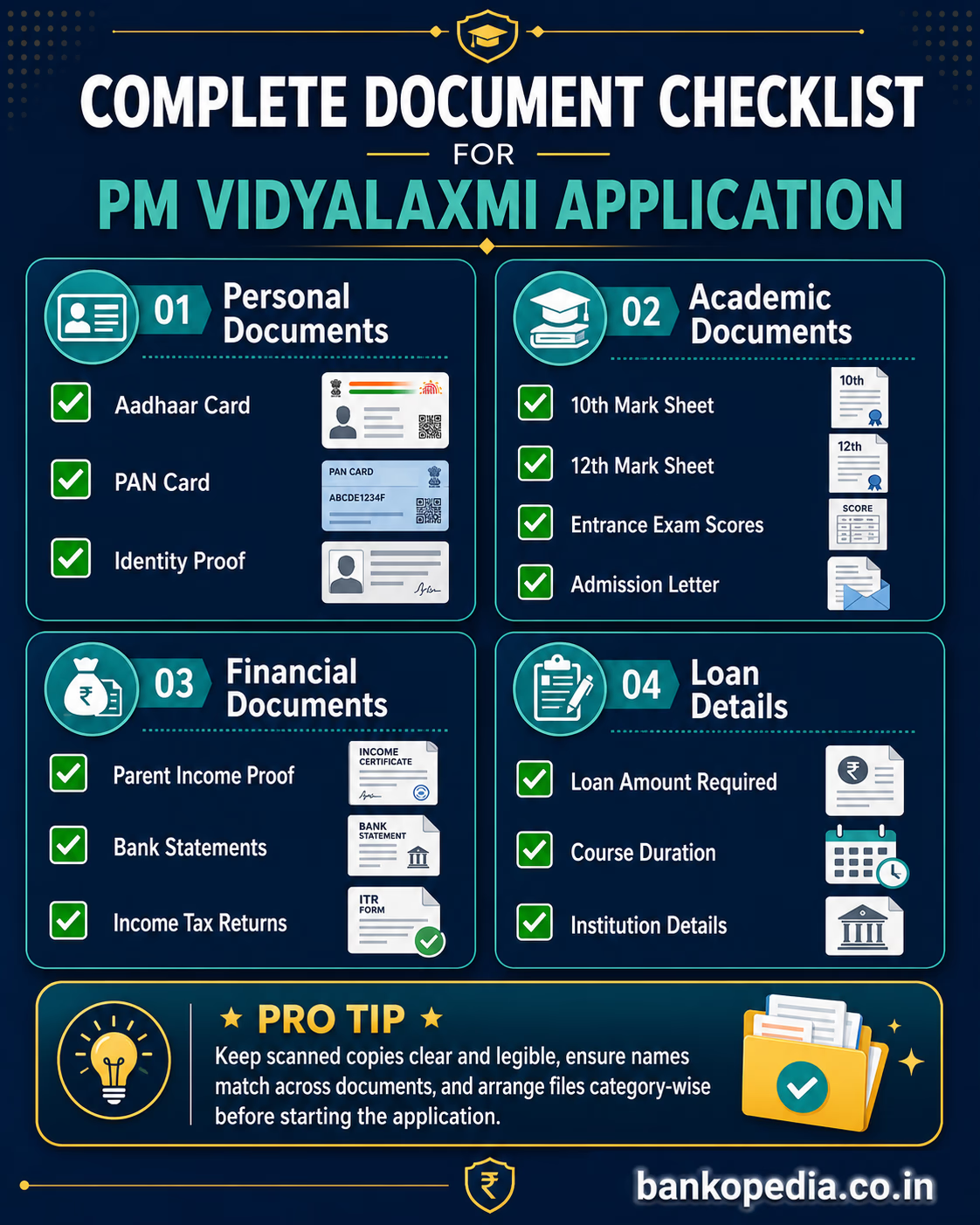
The starting point for identity verification is the Aadhaar card, which serves as the primary route for completing e-KYC — a paperless, electronic identity verification process conducted through the Unique Identification Authority of India's authentication system. Aadhaar-based e-KYC is mandatory wherever applicable as per the Supreme Court's directions on Aadhaar use, making it the seamless and strongly recommended path for most applicants. In addition to Aadhaar, both the student and the co-applicant (usually a parent or legal guardian) must submit a valid PAN card. A recent passport-size photograph of the student is also required and is typically uploaded directly during the online application form. These elements form the baseline identity layer that every participating bank on the portal will verify before processing the loan file.
Academic documents constitute the second critical category. Applicants must upload mark sheets from Class 10 and Class 12 board examinations, along with the mark sheet or scorecard from the qualifying examination relevant to their chosen course — for instance, a JEE rank card for engineering or a NEET scorecard for medical programmes. Equally important is the confirmed admission letter or offer letter from the Quality Higher Education Institution, since the portal's interest subvention benefit is tied exclusively to recognised QHEIs. The institution's current fee structure and prospectus must also be attached, as these documents help the bank calculate the precise loan amount required and verify that the claimed course expenses are legitimate.
For students applying for the 3% interest subvention available to families with an annual income between ₹4.5 lakh and ₹8 lakh, income proof documents become essential. The most accepted document is the latest Income Tax Return, or ITR, filed by the parent or guardian. Salaried co-applicants must additionally provide salary slips for the preceding three months along with a copy of Form 16, which is the employer-issued tax deduction certificate for the financial year. Self-employed co-applicants — such as business owners or professionals — are typically required to furnish either audited business financial statements or a net income certificate issued by a registered Chartered Accountant. Submitting inaccurate income documents can result in subvention claims being rejected even after loan disbursement.
When the requested loan amount exceeds ₹7.5 lakh, most participating banks require tangible collateral — that is, a physical asset pledged as security against the loan. The standard collateral document set includes the property title deed establishing legal ownership, a valuation report prepared by a bank-approved valuer confirming the market value of the asset, an encumbrance certificate (a document proving the property carries no existing legal or financial liabilities), and the most recent property tax receipt. It is worth noting that precise requirements vary between banks and are also influenced by the total loan quantum, so applicants should verify the exact list with the specific lender selected through the portal.
Beyond these standard categories, certain participating banks impose additional document requirements that are not uniformly visible on the central portal. Some lenders request a co-applicant declaration affirming joint repayment responsibility, a scholarship award letter where the student has received financial aid (as this affects the net loan requirement), and a signed acknowledgment of the moratorium repayment schedule — the moratorium being the period during the course and a short window thereafter during which principal repayment is deferred. Because these requirements differ institution by institution, it is strongly advisable to download the specific bank's document checklist directly from the PM Vidyalaxmi Portal before beginning the upload process, rather than relying solely on the general guidelines published on the portal's home page.
Step-by-Step Application Process on the PM Vidyalaxmi Portal
The application journey begins at the official portal — accessible at vidyalakshmi.co.in or the relaunched PM Vidyalaxmi URL notified by the Ministry of Education. Students must register using a valid mobile number linked to their Aadhaar card, India's biometric-based unique identification system. During registration, applicants are encouraged to enter their APAAR ID — short for Academic Bank of Credits ID, a digital academic identifier that stores a student's verified educational history. Where an APAAR ID is provided, the portal automatically pulls in academic records, significantly reducing manual data entry and the risk of errors at this early stage.
Once the student profile is created, the portal's built-in loan comparison tool becomes available. This feature works much like a financial aggregator — it allows students to filter education loan offers from participating public sector and scheduled commercial banks based on parameters such as loan amount, applicable interest rate, repayment tenure, and moratorium terms. As of 2026, interest rates across participating banks range from approximately 8.10% to 11.15% per annum, depending on the lender, the course, and the institution category. A moratorium period, in this context, refers to the repayment-free window that typically covers the course duration plus an additional six to twelve months after course completion, during which the student is not required to service the loan.
After comparing offers, the applicant fills out the Common Education Loan Application Form (CELAF) — a standardised form designed to be completed just once. This single form captures personal details, course and institution information, co-applicant data (usually a parent or guardian), and the income particulars required for interest subvention assessment. The critical advantage here is that the CELAF can be simultaneously submitted to up to three banks, eliminating the need to fill separate applications for each lender. This parallel submission approach, introduced under the PM Vidyalaxmi framework notified on 6th November 2024, meaningfully compresses the overall processing timeline for students.
Following submission, the selected bank's designated loan officer is required to make contact with the applicant within 15 working days. The bank then undertakes document verification and a formal credit appraisal — the process by which a lender evaluates the borrower's repayment capacity, collateral (if any), and creditworthiness. Upon successful appraisal, a sanction letter is issued outlining the approved loan amount, interest rate, repayment schedule, and any conditions attached. Throughout this stage, the portal's integrated status tracker gives applicants real-time visibility into where their application stands — whether it is under review, pending documents, or has been sanctioned — removing the opacity that has historically frustrated education loan applicants in India.
The final stage involves disbursement and government subvention credit. The sanctioned loan amount is not handed to the student directly; instead, it is disbursed directly to the institution in tranches aligned with the academic fee schedule, ensuring funds are used solely for educational expenses. Separately, the government's interest subvention benefit — available to students from families with an annual income between ₹4.5 lakh and ₹8 lakh, covering a 3% subvention during the moratorium on loans up to ₹10 lakh — is credited as an e-voucher to the loan account on a periodic basis. This e-voucher effectively reduces the outstanding principal equivalent, meaning the student's total repayment burden at the end of the moratorium is lower than it would otherwise be. The end-to-end digital architecture of the PM Vidyalaxmi Portal education loan 2026 process is designed to make this subvention credit automatic, requiring no separate application from the student once eligibility is established at the time of loan sanction.
Participating Banks and Their Education Loan Offerings in 2026
All 12 public sector banks in India are mandatorily onboarded on the PM Vidyalaxmi Portal, meaning students can access and compare their education loan products through a single interface without visiting individual bank websites or branches. This mandatory participation was a deliberate policy design choice by the Department of Financial Services, ensuring that the widest range of government-backed lending options is visible to every applicant simultaneously. Among the most prominent offerings are the State Bank of India's two flagship products — the SBI Student Loan Scheme, which targets the general student population, and the SBI Scholar Loan Scheme, which is reserved for students admitted to premier institutions such as the IITs, IIMs, and NITs. Both SBI products are visible and comparable directly on the portal.
Bank of Baroda participates through its Baroda Scholar product, which has historically offered competitive interest rates for students enrolled in top-ranked domestic and international universities. Punjab National Bank lists its PNB Saraswati scheme, a long-standing education loan product aimed at students pursuing graduate and postgraduate courses in India. Canara Bank's offering on the portal is aligned with the IBA Model Education Loan Scheme — a standardised framework developed by the Indian Banks' Association (IBA), the industry body that represents over 250 member banks in India. The IBA model sets benchmark terms that all participating member banks must match or improve upon, including a maximum repayment tenure of up to 15 years after the moratorium period ends — meaning the repayment window of up to 180 equated monthly instalments (EMIs) commences only after the moratorium concludes — and a moratorium period covering the full course duration plus an additional 12 months after course completion, giving students adequate time to find employment before repayments begin.
The portal clearly flags whether a specific bank product is IBA-compliant, which is a practically useful disclosure for applicants. An IBA-compliant product carries a defined floor of borrower protections — standardised prepayment terms, no hidden foreclosure penalties, and a transparent moratorium structure. When comparing loan offers on the portal, applicants should look for this compliance marker before shortlisting a lender, as non-compliant products from newer or smaller institutions may lack these protections even if their headline interest rate appears lower.
Select private sector banks — including HDFC Bank, ICICI Bank, Axis Bank, and Kotak Mahindra Bank — participate in the portal on a voluntary basis. Their involvement significantly broadens the range of choices available to students, and these banks are known for faster digital processing timelines, sometimes disbursing approved loans within five to seven working days. However, voluntary participation means their product terms are not bound by the same mandatory compliance framework as public sector banks, and their interest rates may be structured differently. Students evaluating private sector offers must look beyond the stated or nominal interest rate and examine the Annual Percentage Rate, or APR — a broader measure that includes processing fees, insurance charges, and other upfront costs folded into a single annualised figure, making true cost comparisons far more accurate than comparing headline rates alone.
Interest rate structures across most public sector banks on the portal are linked either to the Repo-Linked Lending Rate (RLLR) or the Marginal Cost of Funds-based Lending Rate (MCLR) — two benchmark rate systems mandated by the Reserve Bank of India. The RLLR, introduced by RBI in October 2019, ties the bank's lending rate directly to the RBI's policy repo rate, while the MCLR is derived from a bank's own cost of funds. Both result in floating-rate loans, which means the Equated Monthly Instalment (EMI) — the fixed periodic payment a borrower makes to repay the loan — can rise or fall whenever the RBI revises the repo rate. As of April 2025, the RBI's repo rate stood at 6.00 percent following a 25-basis-point reduction, which translated into marginal relief on outstanding education loan EMIs for borrowers on RLLR-linked products. Students should factor this variability into their financial planning over a 10 to 15-year repayment horizon.
A critical piece of infrastructure supporting the entire lending ecosystem on the portal is the Credit Guarantee Fund Scheme for Education Loans, or CGFSEL, administered by the Small Industries Development Bank of India (SIDBI). SIDBI is a statutory development finance institution established in 1990 under an Act of Parliament; its role here is to operate a guarantee fund that effectively backstops collateral-free education loans up to ₹7.5 lakh by providing a 75% credit guarantee on outstanding defaults. This means that while the bank's exposure on any given defaulted account is significantly reduced, it retains a 25% residual risk — a critical distinction for loan officers assessing credit risk and capital adequacy requirements on their education loan portfolios.
Interest Subvention Mechanics: How the 3% Benefit Actually Works
Interest subvention is a government subsidy arrangement in which the state absorbs a defined portion of the interest accruing on a borrower's loan account during a specified period, thereby reducing the effective cost of borrowing for the student. Under the PM Vidyalaxmi scheme, this subsidy is not applied across the entire loan tenure. It is restricted specifically to the moratorium period — the window during which the student is still studying and is not yet required to repay the principal or interest. This distinction is important because it determines exactly when the government's financial support kicks in and when the student must begin bearing the full contracted interest rate.
The subvention structure operates in two tiers. Students from families earning up to ₹4.5 lakh per annum receive full (100%) interest subvention during the moratorium under the aligned PM-USP CSIS scheme. The 3% subvention under PM Vidyalaxmi specifically targets the ₹4.5 lakh to ₹8 lakh income bracket — the middle-income segment that previously had no access to government-backed interest relief on education loans.
To understand the practical value of the 3% subvention, a concrete calculation helps. Consider a student who borrows ₹10 lakh at an annual interest rate of 10%. The gross interest accruing each year is ₹1,00,000. With the government absorbing 3 percentage points of that rate, the annual subvention credit comes to ₹30,000, leaving the student's effective interest burden at just 7% per annum during the moratorium. For a student pursuing a four-year undergraduate programme followed by the standard 12-month post-study moratorium, the total subvention period spans five years. Over that window, the cumulative government contribution can reach ₹1.5 lakh or more — and the compounding benefit is actually larger in real terms because interest that is not paid during the moratorium does not capitalise into the outstanding principal, meaning the student's EMI base at repayment commencement is meaningfully lower than it would otherwise have been.
The administrative mechanism for delivering this benefit runs through the National Credit Guarantee Trustee Company, or NCGTC — the nodal agency designated to manage both the credit guarantee and the subvention disbursement under the scheme. Rather than issuing cash directly to students, where the risk of misuse or accounting discrepancies would be significant, NCGTC credits the subvention amount directly to the student's loan account on a quarterly basis. This e-voucher flow ensures that the benefit appears as a verified credit on the lender's books, reduces the scope for leakage, and keeps the audit trail clean for both the bank and the government's monitoring systems.
A critical point that many applicants overlook is that the subvention benefit expires the moment regular EMI repayment begins. Once the moratorium period concludes and the standard repayment schedule commences, the student becomes liable for the full contracted interest rate on the outstanding loan balance — typically the rate quoted by the lender at disbursement, which will vary by institution and loan amount. This makes cash flow planning immediately after course completion essential. Students who anticipate a gap between graduation and first employment, or those entering lower-paying sectors initially, should factor in the full EMI obligation from day one of the repayment phase, not the reduced effective rate enjoyed during the moratorium.
There is an additional financial planning dimension worth noting in the context of Indian income tax law. Under Section 80E of the Income Tax Act, 1961, the entire interest paid on an education loan taken from a recognised financial institution is fully deductible from taxable income, with no upper monetary ceiling on the deduction. This benefit is available for up to eight consecutive assessment years, beginning from the year in which the borrower first starts repaying interest. Crucially, the deduction applies to the net interest actually paid by the student or their parent — meaning the portion subsidised by the government through the 3% subvention is not eligible for the deduction, since it was never borne by the taxpayer in the first place. Students and their families claiming this deduction should therefore maintain separate, clearly labelled records of quarterly subvention credits received during the moratorium, so that their chartered accountant or tax adviser can accurately compute the deductible amount in each financial year and avoid any inadvertent overclaim.
Common Challenges, Rejection Reasons and How to Avoid Them
The single most frequent reason students lose access to the interest subvention benefit under the PM Vidyalaxmi Portal education loan 2026 is that their institution does not appear on the approved list of Quality Higher Education Institutions, or QHEIs. The QHEI list is built using the National Institutional Ranking Framework (NIRF) and covers all HEIs in the NIRF top 100 (overall, category, or domain-specific), State Government HEIs ranked 101–200 in NIRF, and all Central Government institutions. Before submitting any application, applicants should verify whether their college or university appears on the official QHEI list by checking the NIRF portal maintained by the Ministry of Education. Students enrolled in non-listed institutions are not entirely excluded from the portal — they may still access standard education loans from participating banks — but they will not be eligible for the interest subvention component, which is often the most financially significant benefit. Spending ten minutes on a pre-application eligibility check can prevent months of wasted processing time.
Aadhaar-related KYC (Know Your Customer) mismatches represent the second most common source of application holds and outright rejections. The portal relies on Aadhaar-based authentication to verify identity, which means the mobile number linked to an applicant's Aadhaar must be active and accessible at the time of registration. A discrepancy as minor as a middle name appearing in an academic certificate but absent from Aadhaar records — or a spelling variation such as or a spelling variation such as "Mohammed" versus "Mohammad" can trigger an authentication failure that stalls the entire application. To avoid this, applicants should verify that the name on their Aadhaar card matches exactly with the name appearing on their Class 10 marksheet, PAN card, and admission letter before beginning registration. Where discrepancies exist, the Aadhaar name correction process through the UIDAI portal should be completed first — a step that typically takes 7 to 10 working days and is far less disruptive when handled before the application than after.
Income documentation errors form the third major failure point, particularly for self-employed co-applicants. Banks processing applications from families where the primary earner runs a business or professional practice frequently return files that carry informal income declarations rather than properly audited statements or CA-certified net income certificates. The subvention verification system operated by NCGTC cross-references income claims against ITR data available through the income tax department's systems, meaning any inconsistency between the declared income on the application and the ITR on record will flag the file for manual review — significantly extending processing time and potentially resulting in subvention denial even where the loan itself is sanctioned.
Finally, students should be cautious about one procedural misstep that is surprisingly common: applying to more than three banks simultaneously through the portal. The CELAF framework permits a maximum of three parallel submissions. Attempts to route the same application to additional lenders either through the portal or independently through a bank branch — while a portal application is already active — can create duplicate loan inquiries on the applicant's credit bureau report. Multiple hard inquiries within a short window can marginally lower a credit score and signal credit-seeking behaviour to underwriters, subtly reducing the chances of favourable terms on the sanctioned offer.
The PM Vidyalaxmi Portal education loan 2026, taken as a whole, represents the most structurally coherent attempt India has made to bring formal credit within reach of meritorious students across income brackets. Its success, ultimately, will depend less on policy design — which is sound — and more on ground-level execution: how quickly banks process applications, how accurately subvention credits flow through NCGTC, and how effectively students are informed about their eligibility before they commit to institutions or programmes. For aspirants who prepare their documents carefully, verify their institution's QHEI status in advance, and engage with the portal's comparison tools with the same diligence they apply to their entrance examinations, it offers a genuinely transformative financing pathway.