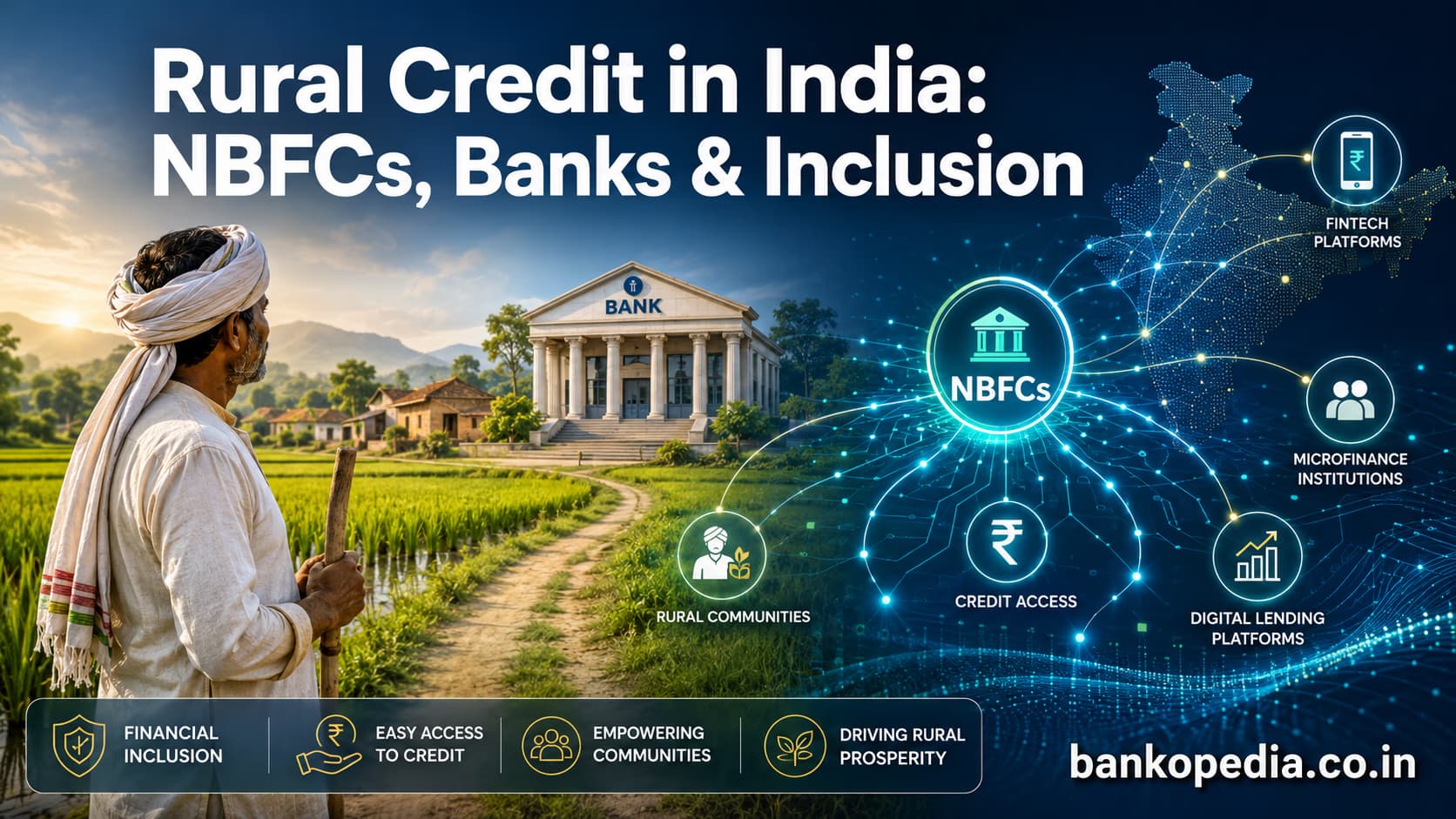
Rural Credit in India: Bridging the Financial Inclusion Divide
India's economic ambition rests substantially on the prosperity of its rural hinterland, where nearly 65% of the population continues to live and work. Yet rural credit and financial inclusion in India remain among the most persistently underserved dimensions of the country's banking landscape. Despite decades of policy intervention, priority sector lending mandates, and the proliferation of Jan Dhan accounts, a structural credit gap endures — one that constrains agricultural productivity, stifles rural entrepreneurship, and deepens economic inequality between urban and rural India. Against this backdrop, Non-Banking Financial Companies (NBFCs), microfinance institutions (MFIs), and an evolving ecosystem of fintech platforms are stepping into spaces that scheduled commercial banks have historically struggled to penetrate. The recent announcement of Purple Finance's acquisition of Saksham Gram Credit signals precisely this trend: organised capital is actively pursuing rural expansion as both a business opportunity and a developmental imperative.
The Rural Credit Gap in India's Financial System
Understanding the rural credit gap requires looking beyond aggregate lending statistics. According to data from the Reserve Bank of India (RBI) and NABARD's All India Rural Financial Inclusion Survey, a significant proportion of rural households — particularly in states like Bihar, Jharkhand, Uttar Pradesh, and Odisha — still depend on informal moneylenders for credit. Interest rates charged by these informal sources frequently range from 24% to 60% per annum, a stark contrast to the 10–14% that formal financial institutions typically charge for comparable loan products.
The structural reasons for this gap are layered and interconnected. First, rural borrowers often lack the documentation — formal income proofs, land title records, credit histories — that conventional underwriting models require. Second, the unit economics of small-ticket loans (often below ₹50,000) are challenging for large banks operating through brick-and-mortar branches that carry high fixed costs. Third, geographical remoteness translates into both higher operational costs and elevated perceived risk for lenders unfamiliar with local agricultural cycles and informal income patterns.
NABARD's 2022–23 report on rural credit estimated that the formal credit requirement for agriculture and allied activities alone stood at approximately ₹30 lakh crore, while actual disbursements remained substantially below that level. The gap is wider still when one accounts for rural non-farm enterprises, housing, and consumption needs that formal lenders have historically underprioritised.
"The challenge is not merely one of supply — it is fundamentally about designing credit products, delivery models, and risk frameworks that are genuinely suited to the rhythms and realities of rural economic life."
Commercial banks, despite their Priority Sector Lending (PSL) obligations — which require 40% of Adjusted Net Bank Credit (ANBC) to flow into priority sectors including agriculture — have often met these targets through indirect routes such as purchasing priority sector lending certificates (PSLCs) rather than through direct origination in underserved rural geographies. This structural workaround, while operationally pragmatic, does little to build long-term lending relationships at the grassroots level.
Role of NBFCs and Microfinance in Rural Expansion
It is in this context that NBFCs and microfinance institutions have emerged as genuinely transformative actors in rural credit and financial inclusion in India. Unlike scheduled commercial banks, many NBFCs have been purpose-built for high-touch, last-mile lending. Their operational models — featuring field officers, local language communication, group lending methodologies, and community-based credit assessment — are structurally better suited to the rural environment.
The NBFC-MFI category, regulated by the RBI under the Master Directions on Non-Banking Financial Company – Micro Finance Institutions (NBFC-MFIs), has grown substantially over the past decade. The gross loan portfolio of the microfinance sector crossed ₹4 lakh crore in FY2023-24, with NBFC-MFIs collectively holding a dominant share. States like Tamil Nadu, Karnataka, West Bengal, and Maharashtra account for the bulk of this portfolio, though penetration into the central and eastern Indian heartland remains comparatively shallow.
The Purple Finance–Saksham Gram Credit acquisition is emblematic of a broader consolidation trend. Smaller, community-rooted NBFCs with strong local networks but limited capital are being absorbed by better-capitalised entities seeking geographic expansion. This consolidation brings scale advantages — access to cheaper capital, superior technology infrastructure, and diversified funding sources — while ideally preserving the ground-level relationship model that makes rural lending viable.
Beyond microfinance, NBFCs specialising in agricultural equipment finance, gold loans, kisan credit cards, and rural housing have significantly widened the formal credit canvas. Gold loan NBFCs like Muthoot Finance and Manappuram have effectively monetised a form of collateral — household gold — that rural households possess in abundance but that traditional bank credit models largely ignored. This has provided millions of rural borrowers with rapid, dignified access to liquidity during agricultural stress periods or family emergencies.
The Self-Help Group (SHG) – Bank Linkage Model
No discussion of rural credit expansion would be complete without acknowledging the Self-Help Group (SHG) – Bank Linkage Programme, facilitated primarily through NABARD. With over 1.4 crore active SHGs linked to banks and a credit outstanding exceeding ₹2.5 lakh crore, this remains one of the largest and most cost-effective rural credit delivery mechanisms in the world. Women constitute the overwhelming majority of SHG members, making this programme a cornerstone of both financial inclusion and women's economic empowerment in rural India.
Government Schemes Supporting Rural Lending
State and central government interventions have played an indispensable role in shaping the rural credit landscape, both by subsidising access and by de-risking lenders operating in inherently uncertain agricultural environments.
Pradhan Mantri Mudra Yojana (PMMY): Since its launch in 2015, MUDRA has sanctioned loans worth over ₹32.6 lakh crore to micro and small enterprises, with a significant proportion flowing to rural non-farm businesses. The scheme operates through three tiers — Shishu (up to ₹50,000), Kishore (₹50,000 to ₹5 lakh), and Tarun (₹5 lakh to ₹10 lakh) — catering to enterprises at different growth stages.
Kisan Credit Card (KCC) Scheme: Administered through commercial banks, RRBs, and cooperative banks, the KCC scheme provides farmers with revolving credit for crop cultivation, post-harvest expenses, and allied activities. The government has progressively expanded its coverage to include fishermen and animal husbandry farmers.
PM SVANidhi: Targeting street vendors — a predominantly urban but economically marginal group — this scheme has provided collateral-free working capital loans, with successful repayment enabling access to enhanced credit limits.
Interest Subvention Scheme: The government provides interest subvention on short-term crop loans up to ₹3 lakh, effectively reducing the cost of institutional credit for farmers to 4% per annum when repaid on time. NABARD administers this subvention for cooperative banks and RRBs.
Credit Guarantee Fund Trust for Micro and Small Enterprises (CGTMSE): By providing collateral-free guarantee cover to lenders, CGTMSE has encouraged banks and NBFCs to extend credit to rural micro-enterprises that cannot offer traditional security.
Regional Rural Banks (RRBs), sponsored jointly by the central government, state governments, and sponsor commercial banks, continue to play a critical intermediary role. Despite their chequered financial history, consolidation and recapitalisation efforts have strengthened many RRBs, and their 22,000-plus branch network in rural and semi-urban areas remains an asset that purely commercial entities find difficult to replicate.
Challenges in Last-Mile Credit Distribution
Progress notwithstanding, the path to genuine rural financial inclusion remains obstructed by a set of stubborn, interrelated challenges that policy and technology have only partially resolved.
Credit Risk Assessment in Informal Economies
Rural incomes are characteristically irregular, often undocumented, and deeply susceptible to climatic and market shocks. Conventional credit scoring models — calibrated on salaried income streams and formal credit histories — are poor predictors of repayment capacity among farmers, artisans, and rural traders. While alternative data sources (satellite imagery for crop assessment, transaction histories from Jan Dhan accounts, utility payment records) are beginning to augment underwriting models, their adoption remains uneven and the regulatory framework around their use is still maturing.
Over-Indebtedness and Multiple Lending
A persistent concern in the microfinance sector is the risk of borrower over-indebtedness — a phenomenon where multiple lenders, competing aggressively for the same borrower pool, extend credit beyond a household's genuine repayment capacity. The RBI's revised regulatory framework for MFIs, introduced in 2022, attempted to address this by capping total indebtedness, mandating income assessment, and requiring a cooling-off period between successive loans. The Credit Bureau coverage of MFI borrowers has improved significantly, but the bureau data's accuracy and timeliness in rural areas remain imperfect.
Human Capital and Operational Costs
Maintaining a skilled field force in rural geographies is expensive and operationally demanding. Staff attrition is high, training pipelines are thin, and the risk of mis-selling or coercive recovery practices — which periodically provoke regulatory and political backlash — is difficult to eliminate entirely. The Andhra Pradesh microfinance crisis of 2010 remains a cautionary reference point for what happens when aggressive growth outpaces responsible lending practices.
Infrastructure Deficits
Unreliable electricity, intermittent internet connectivity, and inadequate road infrastructure continue to impede both branch-based and digital lending in the most underserved rural pockets. Business Correspondent (BC) networks, while expanding, suffer from high dropout rates among agents due to low commission incomes and technology reliability issues at the point of transaction.
How Technology and Digital Payments Enable Rural Credit
If any single force has materially shifted the calculus of rural credit delivery over the past five years, it is the convergence of digital public infrastructure — particularly the India Stack — with affordable smartphones and expanding 4G/5G connectivity.
UPI, Aadhaar, and the Account Aggregator Framework
The Unified Payments Interface (UPI) has not merely transformed retail payments; it has generated a rich seam of transactional data that lenders are increasingly mining to assess creditworthiness. A vegetable seller in a tier-4 town who conducts daily UPI transactions now has a verifiable financial footprint that did not exist five years ago. The Account Aggregator (AA) framework, supervised by SEBI and RBI, takes this further by enabling borrowers to consent to the sharing of their financial data — bank statements, insurance records, GST returns — with lenders in a secure, standardised format. This dramatically compresses loan processing times and reduces documentation burdens for rural applicants.
Video KYC and Digital Onboarding
The RBI's permission for video-based KYC has eliminated one of the most significant friction points in rural lending: the requirement for a borrower to physically visit a branch for documentation. Lenders can now onboard borrowers remotely, verify identity through Aadhaar-based authentication, and disburse loans directly to bank accounts — all within hours rather than days or weeks.
Satellite and Remote Sensing for Agricultural Credit
Agri-fintech companies and progressive NBFCs are deploying satellite imagery and remote sensing data to assess crop health, land records, and irrigation access — enabling underwriting decisions for agricultural loans without requiring a physical field visit. This substantially reduces the cost of originating small-ticket farm loans and improves risk calibration by grounding it in observable ground truth rather than unverifiable borrower declarations.
NBFC-Fintech Co-Lending Partnerships
The RBI's co-lending model (CLM), which allows banks and NBFCs to jointly originate priority sector loans — with banks typically holding 80% and NBFCs 20% of the loan on their respective books — has created a powerful structural incentive for rural credit expansion. Banks gain PSL-compliant assets without bearing origination costs; NBFCs gain access to cheaper bank funding. Fintech platforms operating as technology service providers or lending service providers (LSPs) under this arrangement further enhance reach and processing efficiency.
The broader implications of rural credit and financial inclusion in India through digital infrastructure extend beyond mere convenience. When credit is accessible, affordable, and timely, it enables rural households to invest in productivity-enhancing assets, smooth consumption through income shocks, and graduate from subsistence to surplus — a progression that aggregates, at scale, into meaningful GDP growth and poverty reduction.
Conclusion: A Convergent Path Forward
The expansion of rural credit in India is neither a purely commercial story nor a purely developmental one — it is irreducibly both. The most durable models will be those that achieve financial viability while genuinely serving the credit needs of households and enterprises that have historically been excluded from the formal system.
Several imperatives stand out for the ecosystem's stakeholders. Regulators, particularly the RBI and NABARD, must continue to refine frameworks that balance innovation with consumer protection — the revised MFI guidelines are a positive step, but enforcement consistency and borrower grievance redress at the grassroots level need strengthening. NBFCs and MFIs pursuing rural expansion must invest in responsible lending infrastructure — credit bureau discipline, income assessment rigour, and field staff training — as foundational capabilities rather than compliance afterthoughts. Banks should deepen their co-lending commitments and Business Correspondent networks rather than relying on PSLC purchases as a substitute for genuine rural engagement. And technology providers must prioritise solutions designed for low-literacy, low-connectivity environments rather than simply repackaging urban-centric digital products for rural markets.
Acquisitions like Purple Finance–Saksham Gram Credit, the gradual strengthening of RRBs, and the accelerating adoption of digital onboarding tools collectively suggest that India's rural credit ecosystem is maturing. The gap between ambition and reality remains large — but the directional momentum, for the first time in decades, feels genuinely promising.