Forex Rules for Indian Residents: LRS, Remittance Limits & RBI Compliance Explained
India's foreign exchange landscape is governed by a robust regulatory framework designed to balance the country's capital account management with the aspirations of its residents to transact globally. Understanding forex rules for individuals India RBI has become increasingly critical — whether you are a salaried professional remitting funds for your child's overseas education, an NRI managing cross-border finances, or an individual service exporter navigating the complexities of repatriation. The Foreign Exchange Management Act, 1999 (FEMA) and the Reserve Bank of India's (RBI) evolving directives form the bedrock of these regulations, and staying current is not merely advisable — it is a compliance imperative.
Recent developments have amplified the urgency of this subject. The RBI's massive ₹2.5 lakh crore liquidity infusion has triggered discussions about the trajectory of monetary policy and its implications for forex flows. Meanwhile, RBI Governor Sanjay Malhotra has publicly acknowledged the delicate balancing act central bankers face amid persistent inflation and slowing growth — factors that directly influence exchange rate stability and forex policy. Most critically, more than three weeks after the RBI issued revised forex rules, individual service exporters continue to await clarity, and banks remain without standardized operating procedures (SOPs) — a situation that underscores the practical challenges embedded in India's forex regulatory ecosystem.
This comprehensive guide dissects the key forex regulations applicable to Indian residents, covering the Liberalized Remittance Scheme (LRS), annual remittance caps, special provisions for service exporters, documentation requirements, and compliance best practices.
Understanding India's Forex Regulations for Residents: The FEMA Framework
India's forex regulation framework underwent a paradigm shift in 1999 when the Foreign Exchange Management Act (FEMA) replaced the more restrictive Foreign Exchange Regulation Act (FERA) of 1973. FEMA moved the needle from conservation of foreign exchange to facilitation of external trade and payments, while maintaining orderly development of the forex market in India.

Key Pillars of FEMA
Current Account Transactions: Broadly permitted, with certain categories requiring RBI or Government of India approval. These include payments for travel, education, medical treatment, and gifts/donations abroad.
Capital Account Transactions: More tightly regulated. These involve transactions that alter foreign assets or liabilities, including overseas investments, property purchases abroad, and foreign currency borrowings.
Authorized Persons (APs): Only entities authorized by the RBI — typically banks classified as Authorized Dealer (AD) Category-I and Category-II — can deal in foreign exchange. Money changers and Full Fledged Money Changers (FFMCs) handle retail forex for travel purposes.
The RBI, as the apex regulatory body for forex management, issues Master Directions, circulars, and A.P. (DIR Series) notifications that collectively define the forex rules for individuals India RBI expects compliance with. SEBI intersects with forex regulation in the context of overseas portfolio investments, while IRDAI's role becomes relevant when insurance products involve cross-border premium flows.
Resident vs. Non-Resident: Why It Matters
FEMA defines "person resident in India" broadly — any person residing in India for more than 182 days during the preceding financial year, with specific exceptions for individuals going abroad for employment or business. Your residential status under FEMA determines which forex rules apply to you, the permissible quantum of remittances, and the documentation requirements your bank will enforce.
Key Principle: Under FEMA, all forex transactions by residents are regulated. What is not explicitly permitted is effectively prohibited — the framework operates on a "general prohibition with specific permissions" model for capital account transactions.
Liberalized Remittance Scheme (LRS): Limits & Eligibility
The Liberalized Remittance Scheme, introduced by the RBI in February 2004, represents the most significant liberalization of forex access for individual residents. It allows resident individuals to freely remit funds abroad for both current and capital account transactions, up to a specified annual limit, without requiring prior RBI approval.
Current LRS Limit
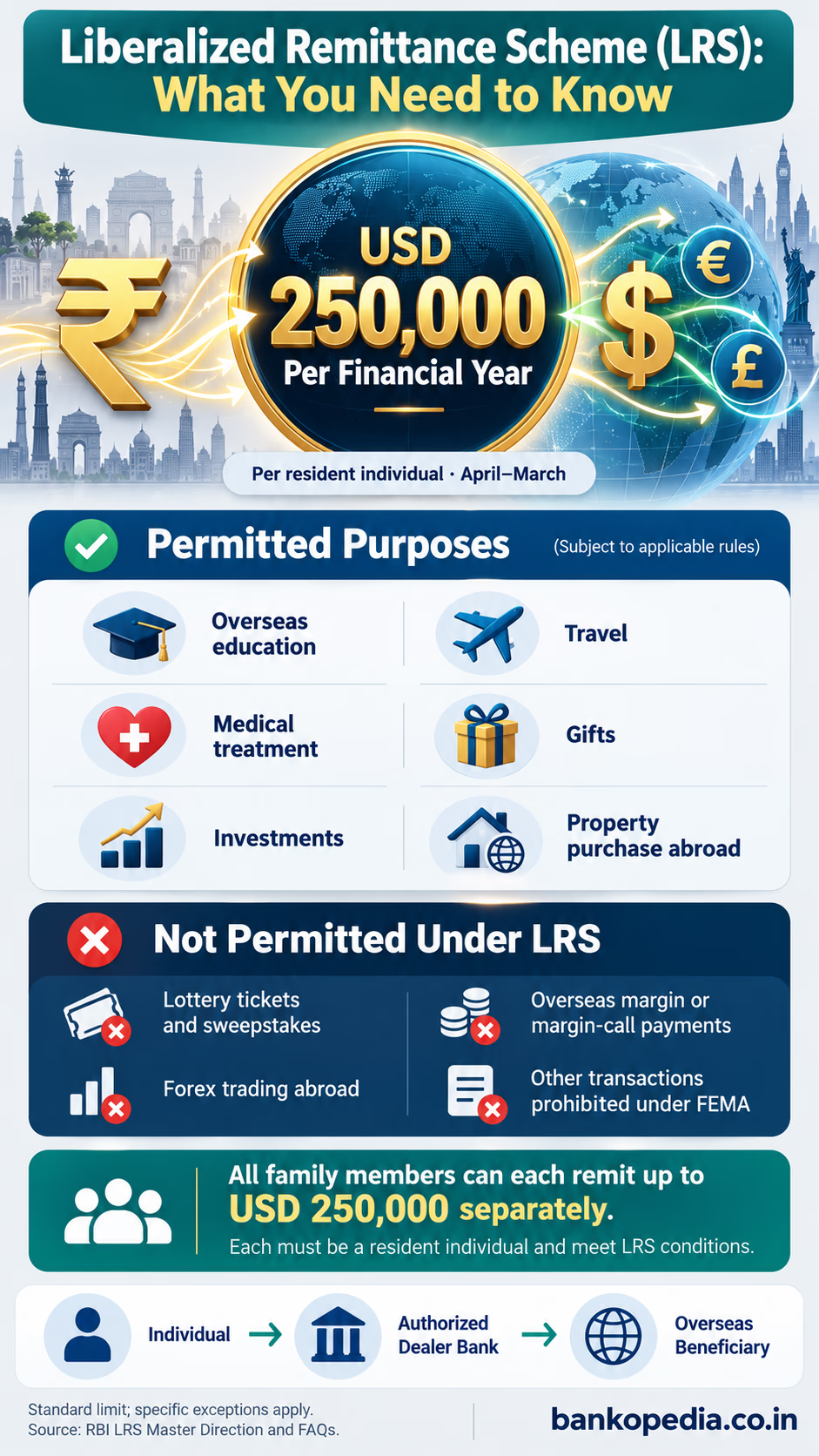
As of FY 2025-26, the LRS limit stands at USD 250,000 per financial year (approximately ₹2.10 crore at prevailing exchange rates). This limit has evolved significantly over the years:
2004: USD 25,000 — the scheme's inception limit.
2007: Raised to USD 200,000 during a period of strong capital inflows.
2013: Temporarily reduced to USD 75,000 amid rupee depreciation pressures.
2015 onwards: Restored and stabilized at USD 250,000.
Who Is Eligible?
All resident individuals, including minors (with the remittance made by the natural guardian on behalf of the minor).
Corporates, partnership firms, HUFs, and trusts are not eligible under LRS.
The individual must have a PAN card and must comply with KYC requirements with the AD bank.
Permitted Purposes Under LRS
The USD 250,000 limit is an umbrella limit covering a wide array of permissible transactions:
Education: Tuition fees, hostel charges, and living expenses for studies abroad.
Medical treatment overseas: Including accompanying attendant's expenses.
Travel (private and business): Foreign currency for personal or business travel.
Gifts and donations: Remittances to relatives or charitable institutions abroad.
Maintenance of close relatives abroad.
Investments: Purchase of immovable property, shares, debt instruments, and opening of foreign currency accounts overseas.
Setting up Joint Ventures (JV) or Wholly Owned Subsidiaries (WOS) abroad — within the LRS limit.
Prohibited Purposes
LRS explicitly does not cover the following:
Remittances to countries identified as "non-cooperative" by the Financial Action Task Force (FATF).
Purchase of lottery tickets, sweepstakes, or proscribed magazines.
Remittances for trading in foreign exchange abroad.
Capital account remittances directly or indirectly to countries like Pakistan, subject to specific restrictions.
Margin or margin calls to overseas exchanges/counterparties.
Tax Collected at Source (TCS) on LRS
Following the Union Budget 2025, the Government of India revised the TCS provisions on LRS remittances under Section 206C(1G) of the Income Tax Act. The key change was the increase of the exemption threshold from ₹7 lakh to ₹10 lakh per financial year. The applicable TCS rates are as follows:
Education funded by education loans: 0.5% TCS on amounts exceeding ₹10 lakh.
Education (not via loan) and medical treatment: 5% TCS on amounts exceeding ₹10 lakh.
All other purposes (including investment, travel, gifts): 20% TCS on amounts exceeding ₹10 lakh.
Overseas tour packages: Under the Budget 2025 framework applicable for FY 2025-26, tour packages attract 5% TCS up to ₹10 lakh and 20% TCS beyond ₹10 lakh. Note: The Union Budget 2026 (effective April 1, 2026) has further simplified this to a flat 2% TCS on overseas tour packages irrespective of the amount.
This TCS is adjustable against the individual's final tax liability while filing income tax returns — it is not an additional tax, but a collection mechanism.
How Much Money Can You Send Abroad? Annual Caps & Rules
The USD 250,000 annual cap under LRS is per individual per financial year (April to March). However, several nuances apply that banking professionals and individuals must understand:
Clubbing and Family Remittances
Each family member — including minors — has an independent LRS limit. A family of four could theoretically remit up to USD 1,000,000 in a financial year. However, the RBI has clarified that clubbing of LRS limits by family members to create a larger pool for a single transaction (e.g., purchasing a single overseas property) is permitted, provided each member independently completes the required documentation and declaration.
Remittances Beyond LRS
Certain current account transactions are outside the LRS framework and have separate limits or permissions:
Business travel: Up to USD 250,000 under LRS, but bonafide business travel expenses may also be met through the employer's forex allocation.
Emigration: Up to USD 250,000 or the amount prescribed by the country of emigration.
Education: If expenses exceed USD 250,000, the AD bank can permit higher remittances based on estimates from the institution abroad. This is a key provision that many individuals are unaware of.
Medical treatment: Similar to education — amounts exceeding USD 250,000 can be remitted with supporting documentation from the hospital/medical institution.
Real-Time Cross-Border Payment Infrastructure
It is worth noting the evolving infrastructure that supports these remittances. As real-time payment systems expand globally — India's UPI-based linkages with Singapore's PayNow, and discussions with other countries' instant payment networks — the mechanics of how money moves between bank accounts are becoming faster and more transparent. However, faster rails do not change the regulatory limits; they merely accelerate settlement within the permitted framework.
Service Exporters & Forex: Special RBI Guidelines
One of the most pressing issues in India's forex landscape in 2025-26 concerns individual service exporters — freelancers, consultants, IT professionals, and creative professionals who earn foreign exchange through cross-border service delivery.
The Regulatory Gap
As widely reported, 23 days after the RBI issued new forex rules, individual service exporters continue to face uncertainty. The revised Master Direction on Export of Goods and Services introduced changes that affect how individuals (as distinct from companies or firms) realize and repatriate export proceeds. The challenge is twofold:
Banks lack SOPs: AD Category-I banks, which are the primary channels for export realization, have not received — or have not internally formulated — clear standard operating procedures for handling individual service export accounts under the new framework.
Documentation ambiguity: The requirements for SoftEx forms (used for software/service exports below a threshold), FIRC (Foreign Inward Remittance Certificate) issuance, and purpose code classification remain inconsistent across banks.
Key Provisions for Individual Service Exporters
Realization period: Export proceeds must be realized within 9 months from the date of export (for services, from the date of invoice). The RBI may grant extensions in specific cases.
EEFC Accounts: Exporters can retain a percentage of export earnings in an Exchange Earners' Foreign Currency (EEFC) account, though the retention limits have been periodically revised.
Write-off provisions: The RBI has prescribed conditions under which unrealized export bills can be written off, but these provisions are primarily designed for corporate exporters and don't always translate neatly to individual service exporters.
Reporting via EDPMS: The Export Data Processing and Monitoring System (EDPMS) maintained by the RBI tracks export realization. Individual service exporters must ensure their AD banks correctly report transactions in EDPMS.
Practitioner's Note: If you are an individual service exporter, it is advisable to maintain a dedicated bank account for export receipts, keep meticulous records of invoices, contracts, and remittance advice, and proactively engage with your AD bank's forex department to clarify applicable procedures. The current regulatory transition period demands vigilance.
Forex Compliance: Documentation & Bank SOPs Explained
Compliance with India's forex regulations is a shared responsibility between the individual remitter and the Authorized Dealer bank. The documentation framework, while sometimes perceived as cumbersome, serves critical objectives: anti-money laundering (AML), combating the financing of terrorism (CFT), and ensuring accurate balance of payments data.
Mandatory Documentation for LRS Remittances
Form A2: The primary application-cum-declaration form for all outward remittances. It captures the remitter's details, purpose of remittance, and a declaration of compliance with FEMA provisions.
PAN Card: Mandatory for all LRS transactions.
Form 15CA/15CB: These Income Tax forms are required for certain categories of outward remittances to ensure tax compliance. Form 15CA is a declaration by the remitter; Form 15CB is a certificate from a Chartered Accountant certifying the nature of the payment, applicable tax rate, and TDS compliance.
Supporting documents: University admission letters (for education), hospital estimates (for medical treatment), property purchase agreements (for overseas investment), and so on.
Bank SOPs: What AD Banks Should Have in Place
The RBI expects AD banks to maintain comprehensive internal SOPs covering:
KYC and enhanced due diligence for forex transactions, particularly for high-value or unusual remittance patterns.
Purpose code validation: Every forex transaction must be classified under the correct RBI purpose code for balance of payments reporting. Misclassification is a compliance risk.
TCS collection and reporting: Banks must compute and collect TCS at the appropriate rate and report it correctly to the Income Tax Department.
Suspicious transaction reporting (STR): Under the Prevention of Money Laundering Act (PMLA), banks must flag and report suspicious forex transactions to the Financial Intelligence Unit – India (FIU-IND).
Operational risk management: The RBI's recent issuance of the Reserve Bank of India (Commercial Banks – Forthcoming Instructions) Second Amendment Directions, 2026 on minimum capital requirements for operational risk reinforces the need for robust internal controls, including in forex operations.
Common Compliance Pitfalls
Exceeding LRS limits without authorization: This constitutes a FEMA contravention and can attract penalties under Section 13 of FEMA.
Incorrect purpose code reporting: Even inadvertent misreporting can trigger regulatory scrutiny during RBI inspections of AD banks.
Failure to realize export proceeds: For service exporters, non-realization within the prescribed period without seeking an extension is a contravention.
Ignoring TCS obligations: While TCS is collected by the bank, individuals must ensure correct reflection in their tax returns to claim credit.
Practical Takeaways and Conclusion
India's forex regulatory framework, anchored by FEMA and administered by the RBI, has evolved considerably toward greater liberalization — but it remains a rules-based system that demands careful compliance. For banking professionals, the imperative is clear: stay updated with every RBI circular, ensure internal SOPs reflect the latest requirements, and invest in training frontline staff who handle forex transactions daily.
For individual residents, the key takeaways are:
Know your LRS limit: USD 250,000 per financial year is your umbrella cap for most personal and investment remittances abroad.
Plan for TCS: Factor in the 0.5% to 20% TCS on remittances above ₹10 lakh (revised upward from ₹7 lakh by Union Budget 2025), and ensure you claim credit while filing your ITR.
Documentation is non-negotiable: Form A2, PAN, 15CA/15CB, and supporting documents must be in order before approaching your AD bank.
Service exporters — stay proactive: The current regulatory transition demands direct engagement with your bank's forex team. Do not assume that procedures are standardized across banks; they are demonstrably not.
Seek professional advice for complex transactions: Overseas property purchases, setting up foreign JVs or WOS, and large investment remittances warrant consultation with a FEMA-specialized Chartered Accountant or legal advisor.
As the RBI continues to refine its forex framework — balancing macroeconomic stability with the legitimate needs of a globalizing Indian populace — the importance of understanding forex rules for individuals India RBI will only intensify. Whether you are a banker processing a student's tuition remittance or a freelancer receiving payment from an overseas client, regulatory literacy is your first line of defense against compliance risk.
This article is published on Bankopedia (bankopedia.co.in) for educational purposes. Readers are advised to verify current provisions through the RBI's official website (rbi.org.in) and consult qualified professionals for transaction-specific guidance.


