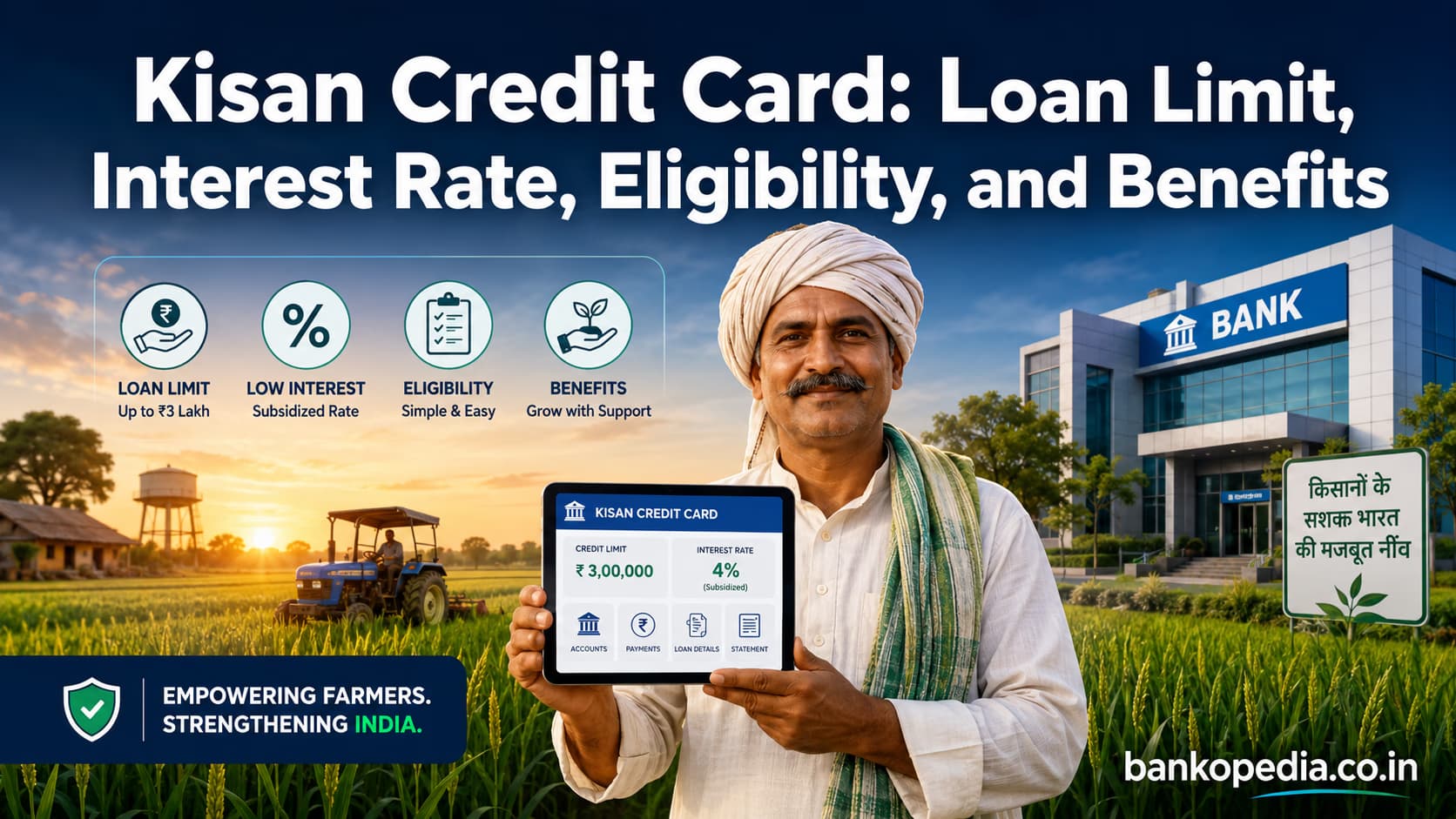
Kisan Credit Card 2026: Key Details at a Glance
Particular | Current Position |
|---|
Scheme | Kisan Credit Card (KCC) |
Introduced | 1998 |
KCC/MISS lending limit | Enhanced from ₹3 lakh to ₹5 lakh |
Collateral-free agricultural loan limit | ₹2 lakh per borrower |
Standard concessional rate under MISS | 7% p.a. on the eligible short-term loan component |
Prompt Repayment Incentive | Up to 3% |
Effective interest rate for eligible prompt borrowers | As low as 4% p.a. |
Major beneficiaries | Farmers, tenant farmers, sharecroppers, SHGs and JLGs |
Allied activities | Dairy, animal husbandry and fisheries |
Operational KCC accounts in 2025–26 | 7.28 crore |
Outstanding KCC amount | ₹10.08 lakh crore |
Major digital initiatives | Kisan Rin Portal, Jan Samarth, e-KCC and KRISHIKA |
Sources: Government of India, PIB and RBI. (Press Information Bureau)
Latest Kisan Credit Card News in 2026
The KCC ecosystem has undergone several important changes over the last two years.
The Union Budget 2025–26 announced an increase in the loan limit under the Modified Interest Subvention Scheme (MISS) from ₹3 lakh to ₹5 lakh for loans taken through Kisan Credit Cards. Government publications in 2026 have continued to describe the enhanced KCC/MISS lending limit as ₹5 lakh. (Press Information Bureau)
Another major change was the increase in the collateral-free short-term agricultural loan limit from ₹1.60 lakh to ₹2 lakh per borrower, effective from 1 January 2025. The change is particularly relevant for small and marginal farmers because eligible loans within this limit generally do not require additional collateral security. (Press Information Bureau)
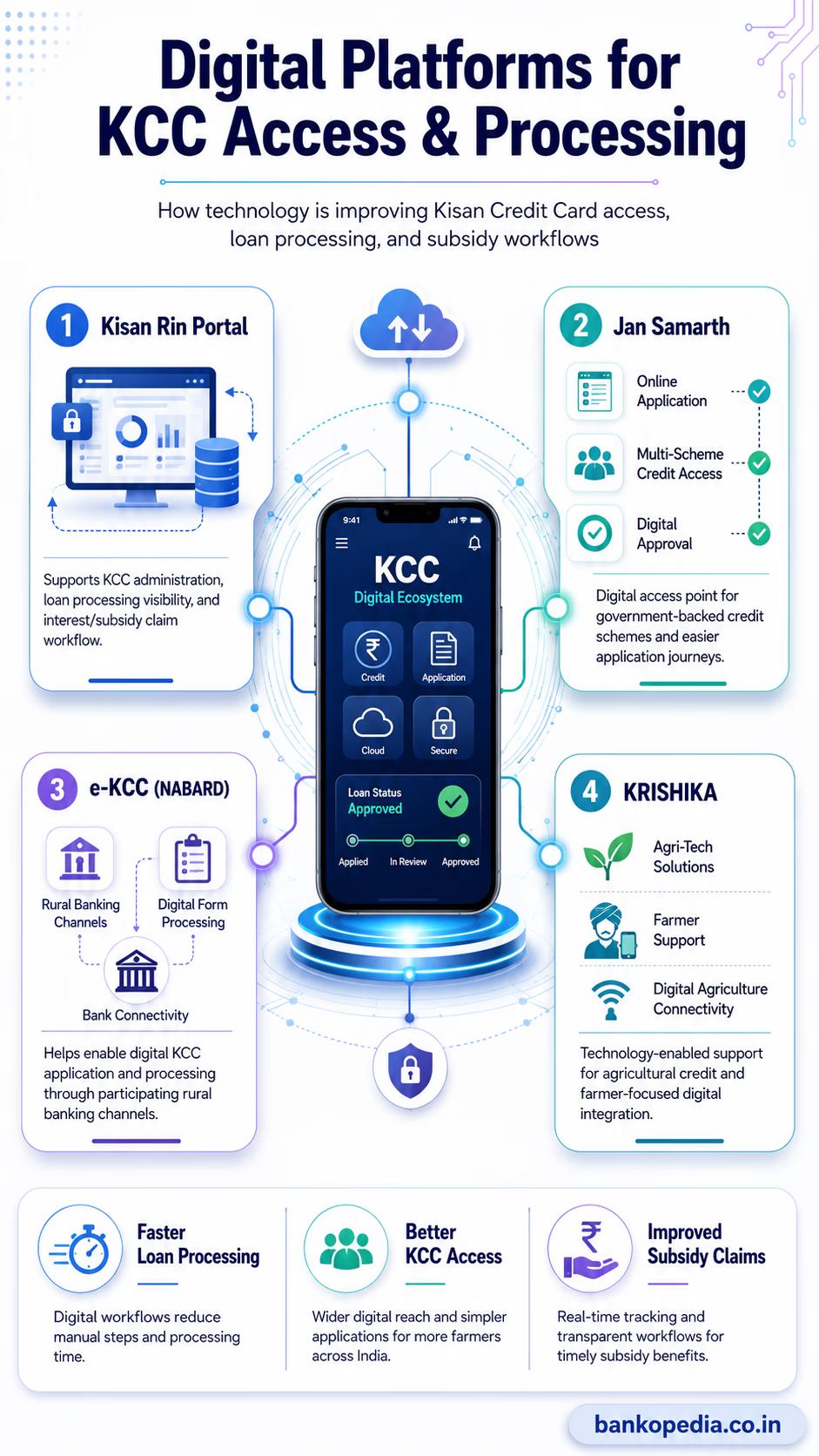
The government is also increasingly digitising agricultural credit. Platforms such as the Kisan Rin Portal, Jan Samarth, NABARD's e-KCC platform and KRISHIKA are being used to improve loan processing, subsidy claims and access to KCC facilities. Availability of particular digital application facilities can vary by bank and state. (Press Information Bureau)
Latest KCC Numbers: 7.28 Crore Operational Accounts
Government data released in August 2026 shows the scale of the Kisan Credit Card programme.
During 2025–26, approximately 7.28 crore KCC accounts were operational across India, while the total outstanding amount under these accounts stood at approximately ₹10.08 lakh crore. (Press Information Bureau)
For comparison, there were approximately 7.75 crore operative accounts with ₹9.82 lakh crore outstanding during 2023–24, while outstanding KCC credit had crossed ₹10 lakh crore in subsequent years. (Press Information Bureau)
This makes KCC one of the largest formal agricultural credit mechanisms in India.
What is a Kisan Credit Card?
The Kisan Credit Card Scheme was introduced in 1998 to provide farmers with convenient access to bank finance without requiring them to apply for a separate agricultural loan every time they need funds.
The facility works broadly like a revolving agricultural credit limit. Subject to the sanctioned limit and bank conditions, the farmer can draw money when required and repay it according to the crop cycle and repayment schedule.
The credit can be used for crop cultivation, purchase of seeds, fertilisers and pesticides, post-harvest expenditure, produce marketing, certain household consumption requirements, maintenance of farm assets and investment in agricultural or allied activities. (Press Information Bureau)
Who is Eligible for Kisan Credit Card?
KCC is not restricted only to farmers who own agricultural land.
Under the broad RBI framework, eligible borrowers include individual farmers and joint borrowers who are owner-cultivators, tenant farmers, oral lessees, sharecroppers and Self Help Groups or Joint Liability Groups of farmers, including groups involving tenant farmers and sharecroppers. (Press Information Bureau)
The scheme was subsequently extended to provide working-capital support for animal husbandry, dairy and fisheries. RBI's framework covers eligible fishers, fish farmers, poultry farmers, livestock farmers and dairy farmers, subject to the relevant activity and bank assessment. (Reserve Bank of India)
Kisan Credit Card Loan Limit in 2026
One of the biggest developments is the enhancement of the KCC/MISS lending limit.
The Union Budget 2025–26 increased the loan limit under MISS from ₹3 lakh to ₹5 lakh for KCC borrowers. Government publications during 2026 continue to reference this enhanced ₹5 lakh limit. (Press Information Bureau)
However, ₹5 lakh should not automatically be interpreted as the amount every farmer will receive.
The actual sanctioned limit depends on factors such as the area cultivated, type of crop, district-level scale of finance, cropping pattern, post-harvest requirements, maintenance expenses, existing liabilities, allied activities and the bank's assessment of repayment capacity. (Reserve Bank of India)
For example, under the RBI KCC framework, the first-year short-term crop requirement is broadly calculated using the scale of finance for the crop multiplied by the area cultivated, with additional amounts provided for specified post-harvest, household, farm-maintenance and insurance requirements. Future drawable limits can then account for increases in cultivation costs or the scale of finance. (Reserve Bank of India)
Therefore, KCC is fundamentally a need-based agricultural credit facility, rather than a fixed ₹5 lakh loan available automatically to every applicant.
KCC Interest Rate: Can Farmers Really Get Loans at 4%?
The Modified Interest Subvention Scheme is designed to reduce the cost of short-term agricultural credit.
Government guidance states that eligible short-term KCC loans are provided at a concessional rate of 7% per annum. Farmers who repay eligible loans on time can receive a Prompt Repayment Incentive of up to 3%, bringing the effective rate down to approximately 4% per annum. (Prime Minister of India)
There is, however, an important distinction that KCC borrowers should understand.
Although the overall MISS/KCC lending limit has been enhanced from ₹3 lakh to ₹5 lakh, the Government's March 2026 KCC explainer still states that short-term agricultural loans up to ₹3 lakh are available at 7%, with the additional 3% benefit for prompt repayment. (Press Information Bureau)
Therefore, borrowers should not assume that the effective 4% rate automatically applies to the entire ₹5 lakh sanctioned amount. The eligible subsidised portion should be confirmed with the lending bank according to the applicable MISS guidelines at the time of sanction.
This distinction is particularly important when comparing KCC offers from different banks.
Collateral-Free KCC Loan Limit
The collateral-free agricultural loan threshold has been increased to ₹2 lakh per borrower, effective from 1 January 2025. (Press Information Bureau)
This means an eligible farmer receiving a qualifying agricultural loan within this threshold generally does not need to provide additional collateral such as property.
For higher amounts, security requirements can depend on the type of loan, lending bank and whether an approved tie-up arrangement exists. SBI, for example, lists additional security documentation for KCC limits above applicable thresholds, while PNB's agricultural-credit guidelines similarly distinguish security requirements according to the amount and type of arrangement. (State Bank of India)
What Can KCC Money Be Used For?
KCC is wider than a simple crop-production loan. It can support short-term crop cultivation, post-harvest requirements, produce marketing, household consumption associated with the farming household, maintenance and repair of farm assets, working capital for allied activities and eligible agricultural investments.
The scheme's expansion into dairy, livestock and fisheries is particularly important because a farmer may have multiple sources of agricultural income rather than depending on a single crop. (Press Information Bureau)
Documents Required for Kisan Credit Card
Exact documentation varies between banks, but major banks generally require a completed agricultural loan application, recent photographs, KYC documents such as Aadhaar or another acceptable identity/address document, proof of agricultural landholding or eligible cultivation rights, details of crops and acreage and any additional security documents required for higher loan amounts.
For example, SBI currently specifies the application form, photographs, certified landholding proof and cropping-pattern details among its KCC documentation requirements. PNB similarly specifies identity proof, residence proof and recent photographs for agricultural credit applications. (State Bank of India)
Tenant farmers, lessees, JLGs, SHGs, dairy farmers and fishers may require different evidence depending on the activity and the lending bank's policy.
How to Apply for Kisan Credit Card
Farmers can approach participating commercial banks, Regional Rural Banks, cooperative banks and other eligible lending institutions offering the KCC facility.
Digital access is also increasing. The Government has introduced Jan Samarth as a digital platform connecting various government-backed credit schemes. NABARD has introduced an e-KCC platform for Regional Rural Banks and Rural Cooperative Banks, while individual banks are increasingly providing digital agriculture-loan services. (Press Information Bureau)
However, digital availability is not identical across India. A farmer may still need to visit the concerned bank branch for land-record verification, documentation, field verification or completion of sanction formalities.
How is the KCC Limit Calculated?
A common misconception is that every farmer is entitled to exactly ₹5 lakh.
The bank primarily calculates the crop-production requirement using the district's Scale of Finance, the farmer's acreage and cropping pattern. Additional eligible components may then be included for post-harvest expenses, maintenance of agricultural assets, household requirements, insurance and agricultural investments.
For non-marginal farmers, RBI's KCC framework also allows the maximum permissible limit to incorporate estimated long-term agricultural investment requirements over the KCC period. (Reserve Bank of India)
Consequently, two farmers owning the same amount of land may receive different KCC limits if they cultivate different crops or have different farming requirements.
KCC for Dairy, Animal Husbandry and Fisheries
KCC was expanded to cover the working-capital requirements of animal husbandry and fisheries, substantially increasing its relevance beyond crop cultivation.
Eligible activities can include dairy farming, poultry, sheep and goat rearing, piggery, fisheries, aquaculture and other qualifying activities. The applicable scale of finance is generally determined according to local costs and may be calculated per animal, bird, acre or production unit depending on the activity. (Reserve Bank of India)
Government policy material in 2026 also references enhancement of the KCC lending limit for fisheries and allied activities to ₹5 lakh. (Press Information Bureau)
Digital KCC and Kisan Rin Portal
Technology is becoming an increasingly important part of agricultural lending.
The Kisan Rin Portal (KRP) was introduced to digitise the administration of the Modified Interest Subvention Scheme and improve the processing of interest-subvention and Prompt Repayment Incentive claims.
The Government has also highlighted Jan Samarth, e-KCC and KRISHIKA as technological interventions intended to streamline agricultural credit delivery. (Press Information Bureau)
Digitalisation could gradually reduce paperwork, improve visibility of KCC accounts and make credit delivery faster, although the level of end-to-end digitisation still varies between banks.
Does Timely Repayment Matter?
Yes. Timely repayment is particularly important under KCC because the additional Prompt Repayment Incentive is linked to repayment within the prescribed period.
Eligible farmers receiving the incentive can reduce their effective interest cost from the concessional 7% rate to approximately 4%. If the borrower does not meet the required repayment conditions, the Prompt Repayment Incentive may not be available and the applicable interest burden can therefore increase. (Prime Minister of India)
Farmers should check the exact due date applicable to their crop cycle instead of assuming that every KCC loan follows the same repayment date.
KCC's Impact on Indian Agriculture
A third-party assessment released by the Government in August 2026 found that every ₹1 invested under KCC-MISS contributed an estimated ₹2.30 to net value addition in agriculture and allied sectors.
The assessment also reported that the scheme improved access to working capital, cropping intensity, multi-season cultivation and income diversification through activities such as livestock and fisheries. The estimated cumulative subsidy outlay under MISS was approximately ₹1.87 lakh crore up to 2024–25. (Press Information Bureau)
These findings show why affordable agricultural credit is important not simply as a loan programme but as an instrument for moving farmers away from expensive informal borrowing.
Frequently Asked Questions
What is the Kisan Credit Card limit in 2026?
The Government enhanced the KCC loan limit under the Modified Interest Subvention Scheme from ₹3 lakh to ₹5 lakh. The actual amount sanctioned to an individual farmer depends on landholding, crop, scale of finance, allied activities and bank assessment. (Press Information Bureau)
Is a ₹5 lakh KCC loan collateral-free?
No. The general collateral-free agricultural loan threshold is ₹2 lakh per borrower. Security requirements for amounts beyond the applicable collateral-free threshold depend on the bank and loan arrangement. (Press Information Bureau)
Is KCC interest only 4%?
Eligible short-term loans are generally priced at the concessional rate of 7%, and eligible borrowers who repay promptly can receive an additional incentive of up to 3%, reducing the effective cost to approximately 4% on the qualifying amount. (Prime Minister of India)
Does the 4% rate apply to the entire ₹5 lakh?
Borrowers should verify this with their bank. While the overall MISS/KCC limit has been enhanced to ₹5 lakh, the Government's March 2026 KCC explainer separately states that the 7% concessional rate and 3% prompt-repayment benefit apply to short-term agricultural loans up to ₹3 lakh. (Press Information Bureau)
Can tenant farmers get a Kisan Credit Card?
Yes. RBI's KCC framework includes tenant farmers, oral lessees and sharecroppers, as well as eligible SHGs and JLGs. (Reserve Bank of India)
Can dairy farmers and fishermen apply for KCC?
Yes. The scheme has been expanded to provide working-capital support for animal husbandry, dairy and fisheries. (Reserve Bank of India)
Conclusion
The Kisan Credit Card has evolved from a traditional crop-finance product into a broader agricultural credit platform covering crop cultivation, livestock, dairy and fisheries.
The enhancement of the KCC/MISS lending limit to ₹5 lakh, the increase in the collateral-free loan threshold to ₹2 lakh, expansion of digital credit channels and the continuation of concessional short-term agricultural finance have strengthened its role in India's rural credit system. (Press Information Bureau)
With 7.28 crore operational KCC accounts and around ₹10.08 lakh crore outstanding during 2025–26, KCC remains one of the most important channels through which India's banking system provides formal working capital to farmers. (Press Information Bureau)
Bankopedia Note: Loan limits, interest subsidy eligibility, repayment periods, security requirements and documentation can change according to Government guidelines and individual bank policies. Farmers should verify the latest applicable terms with their bank before applying.