The scheme is designed as a progressive credit system. A vendor starts with a relatively small working-capital loan. Timely repayment creates a repayment record and allows the borrower to move to a higher loan tranche.
Following restructuring of the programme, responsibility for implementation is shared by MoHUA and the Department of Financial Services, with financial institutions providing the actual loans and credit facilities.
PM SVANidhi Loan Amount in 2026
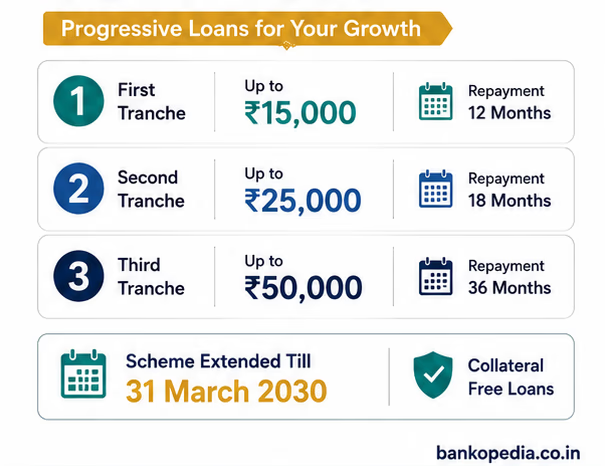
The current PM SVANidhi loan structure consists of three progressive tranches:
Loan Stage | Maximum Loan | Repayment Period |
|---|
First Tranche | ₹15,000 | 12 months |
Second Tranche | ₹25,000 | 18 months |
Third Tranche | ₹50,000 | 36 months |
The first tranche was previously limited to ₹10,000 and the second tranche to ₹20,000. Following the restructuring approved in August 2025, these limits were increased to ₹15,000 and ₹25,000 respectively. The third tranche remains ₹50,000.
The higher tranches are therefore not simply additional loans available to every applicant immediately. The structure rewards borrowers who successfully service earlier loans.
Is PM SVANidhi Loan Collateral-Free?
Yes.
PM SVANidhi provides collateral-free working-capital loans to eligible street vendors. Borrowers are not required to pledge property or conventional security for these loans.
This is particularly important for small vendors who may own a cart, stall or small inventory but do not possess assets that can normally be offered as bank collateral.
7% Interest Subsidy
An important benefit of PM SVANidhi is an interest subsidy of 7% for eligible borrowers making timely repayments.
This reduces the effective cost of borrowing and encourages regular repayment behaviour. Government material published in 2026 continues to list the 7% interest subsidy as one of the scheme's benefits.
Borrowers should remember that the actual lending rate applicable to the loan and the subsidy are separate concepts. They should check the loan terms provided by their lending institution before accepting the facility.
New PM SVANidhi RuPay Credit Card
One of the most important additions to the restructured scheme is the UPI-linked RuPay Credit Card.
Street vendors who successfully repay their second PM SVANidhi loan tranche can become eligible for the credit-card facility. The card can provide a credit limit of up to ₹30,000, giving vendors additional flexibility when they require short-term funds.
The credit-card facility was formally launched on 23 January 2026.
This represents a significant evolution in PM SVANidhi.
The programme initially focused mainly on term loans. An eligible vendor can now potentially build a progression such as:
₹15,000 loan → ₹25,000 loan → RuPay Credit Card → ₹50,000 third-tranche loan
This can help establish a formal borrowing and repayment history that may later make it easier for vendors to access other financial products.
Digital Payment Cashback Under PM SVANidhi
PM SVANidhi also encourages vendors to accept digital payments.
Under the current framework, eligible vendors can receive cashback of up to ₹100 per month for 12 months, or a maximum of ₹1,200 per year, for qualifying digital transactions during each loan tranche.
The restructured scheme also introduced cashback for eligible wholesale digital purchases. Vendors can receive up to ₹100 per quarter for four quarters for qualifying wholesale purchases of at least ₹2,000.
Together, the scheme provides digital-payment incentives of up to approximately ₹1,600 under the relevant conditions.
Digital adoption among PM SVANidhi borrowers has become substantial. Government data reported that more than 875 crore digital transactions had been carried out by beneficiaries up to May 2026, while around ₹412 crore had been released as cashback incentives.
Who Is Eligible for PM SVANidhi?
PM SVANidhi primarily targets eligible street vendors identified under the framework of the Street Vendors (Protection of Livelihood and Regulation of Street Vending) Act, 2014.
Identification and certification of vendors is undertaken by States, Union Territories and Urban Local Bodies.
The scheme can cover different types of vendors, including:
stationary street vendors,
mobile vendors,
seasonal vendors,
women vendors,
tourism-dependent vendors,
food vendors,
vegetable and fruit sellers,
tea and snack vendors,
hawkers and cart operators,
other eligible street-based micro-businesses.
The government clarified in July 2026 that seasonal, mobile, women and tourism-dependent vendors can be covered provided they meet the applicable eligibility requirements.
PM SVANidhi Is Expanding Beyond Major Urban Areas
Another important recent development is geographical expansion.
PM SVANidhi was initially concentrated in statutory urban areas, although eligible vendors from surrounding peri-urban locations who operated within ULB boundaries could also be covered.
Under the restructured scheme, coverage is being expanded gradually to include census towns and additional peri-urban areas.
The official PM SVANidhi portal now explicitly states that vendors from Census Towns are eligible to access loans and other scheme benefits.
This could materially increase the number of small vendors able to enter the formal credit system.
How to Apply for PM SVANidhi Loan
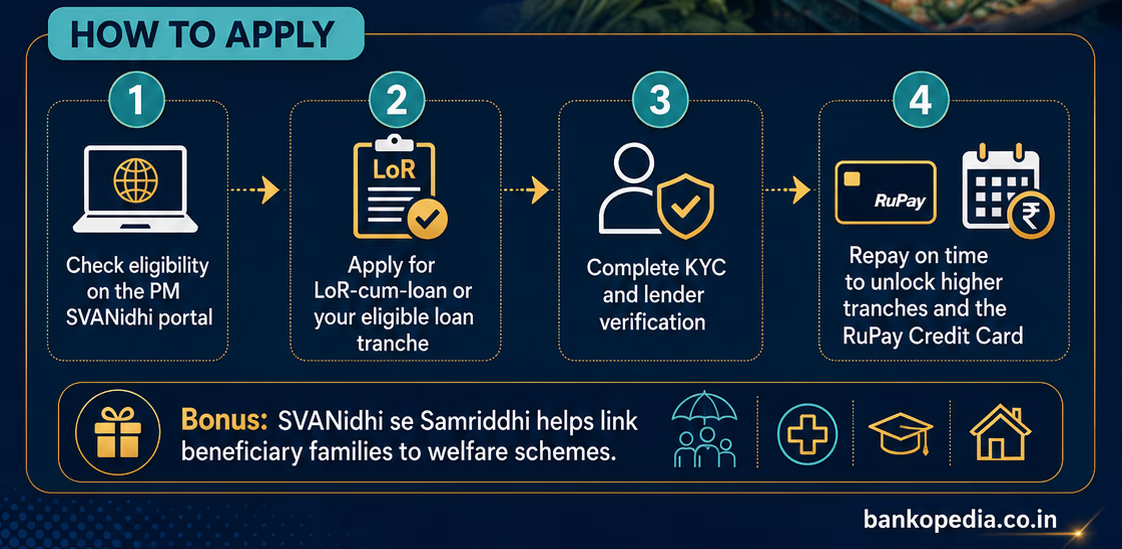
Applicants can use the official PM SVANidhi portal.
The portal currently provides separate facilities to:
apply for an LoR-cum-loan,
apply for the ₹15,000 loan,
apply for the ₹25,000 loan,
apply for the ₹50,000 loan,
apply for the PM SVANidhi Credit Card,
check application status,
check vendor survey status,
request transfer between Urban Local Bodies where applicable.
The government's portal recommends three preliminary steps:
Understand the applicable loan requirements and check eligibility.
Ensure the applicant's mobile number is linked with Aadhaar for the relevant digital process.
Check eligibility status according to PM SVANidhi scheme rules.
Applicants who have not been included in an Urban Local Body survey may need to follow the applicable process for verification or a Letter of Recommendation (LoR).
How Long Does PM SVANidhi Loan Approval Take?
According to information released by the Ministry of Housing & Urban Affairs in July 2026, the PM SVANidhi portal showed an average loan-sanction time of approximately 23 days.
Actual processing time can vary depending on verification, documentation, the Urban Local Body and the lending institution.
What Is SVANidhi se Samriddhi?
PM SVANidhi is no longer limited to lending.
The SVANidhi se Samriddhi component conducts socio-economic profiling of beneficiary families and helps connect eligible households with other government welfare programmes.
As of 12 July 2026, socio-economic profiling had been completed for 50.63 lakh PM SVANidhi beneficiaries, with around 1.56 crore welfare-scheme sanctions extended through the initiative.
The programme links eligible households with eight Central Government schemes, including schemes related to insurance, pensions, banking, food security and maternity support.
This makes PM SVANidhi more than a micro-loan programme. It increasingly functions as an entry point to India's wider financial and social-security ecosystem.
Has PM SVANidhi Actually Improved Vendor Income?
Government-reported independent impact assessments conducted by the Indian School of Business, Hyderabad, in 2023 and 2025 provide some useful indicators.
The 2023 assessment covered more than 5,000 beneficiaries in 100 Urban Local Bodies and found that PM SVANidhi represented the first bank loan for approximately 95% of beneficiaries.
A follow-up study conducted in 2025 across 99 ULBs found that average annualised business income among surveyed PM SVANidhi borrowers increased by around 20% between 2023 and 2025.
Around 30% of borrowers also reported having loans outside the PM SVANidhi programme, suggesting that some beneficiaries were subsequently gaining access to the wider formal-credit market.
These findings are important because one of the longer-term benefits of the scheme may be the creation of a visible repayment and credit history for borrowers who previously operated almost entirely outside formal banking.
The strongest impact of PM SVANidhi may therefore not simply be the ₹15,000 or ₹50,000 loan itself.
A small vendor who previously relied entirely on informal borrowing can potentially gain:
Bank account → Formal working-capital loan → Repayment history → Digital transactions → Higher loan tranche → Credit card → Wider access to formal credit
For banks, this creates data about repayment behaviour and digital cash flows.
For vendors, it creates a financial identity.
This is why PM SVANidhi increasingly sits at the intersection of micro-credit, financial inclusion, digital payments and formalisation of India's informal economy.
Latest PM SVANidhi Developments to Watch in 2026
Several developments are worth tracking during the remainder of 2026.
1. UPI-Linked RuPay Credit Card Expansion
The credit card for second-tranche borrowers is now operational. Wider issuance could gradually provide qualifying vendors with revolving working-capital access instead of requiring them to rely entirely on individual term loans.
2. Expansion into Census Towns
The extension beyond conventional statutory urban areas potentially brings a much larger segment of small-town vendors into the programme.
3. Street Food Hubs
MoHUA has also issued guidelines to States and Union Territories for developing Street Food Hubs under PM SVANidhi, with an emphasis on organised, safe vending spaces in high-footfall and tourist locations.
4. Digital Transactions and Formal Credit Histories
With hundreds of crores of digital transactions already taking place among beneficiaries, transaction history and repayment behaviour could increasingly help street vendors transition from informal borrowing towards mainstream banking.
Frequently Asked Questions
What is the maximum PM SVANidhi loan amount in 2026?
The highest term-loan tranche under the scheme is currently ₹50,000. Borrowers generally progress through ₹15,000, ₹25,000 and ₹50,000 tranches based on applicable repayment and eligibility conditions.
What is the first PM SVANidhi loan amount?
The first tranche is now available for up to ₹15,000, increased from the earlier ₹10,000 limit.
Is PM SVANidhi loan secured?
No. It is a collateral-free working-capital loan for eligible street vendors.
Is there any interest subsidy?
Yes. Eligible borrowers making timely repayments can receive a 7% interest subsidy, subject to the scheme's applicable conditions.
Can a PM SVANidhi borrower get a credit card?
Eligible street vendors who have successfully repaid their second loan tranche can access the UPI-linked RuPay Credit Card, with a limit of up to ₹30,000 under the programme.
Is PM SVANidhi available in census towns?
Yes. The restructured scheme is expanding coverage beyond statutory towns, and the official portal states that vendors from Census Towns are now eligible for scheme benefits.
When will PM SVANidhi end?
The lending period of the restructured PM SVANidhi scheme has been extended until 31 March 2030.
Conclusion
PM SVANidhi has evolved considerably from the emergency micro-credit programme launched in 2020.
The 2026 version of the scheme provides a clearer path towards financial progression: ₹15,000 first-tranche financing, ₹25,000 second-tranche financing, a UPI-linked RuPay Credit Card for eligible borrowers, and a third-tranche loan of up to ₹50,000.
With 76.95 lakh vendors having availed more than 1.15 crore loans worth approximately ₹18,475 crore by 12 July 2026, the scheme is now operating at substantial scale.
Its longer-term importance lies in what happens beyond the first loan. Regular repayment, digital payment adoption and progressive access to higher credit limits can help a street vendor build a formal financial history and gradually move away from expensive informal borrowing.
For millions of small urban and increasingly small-town businesses, that transition from informal borrower to recognised banking customer could prove to be PM SVANidhi's most significant contribution.