Waste-to-energy
Green hydrogen
Wind-solar hybrid projects
Battery and other energy-storage systems
Renewable-energy transmission infrastructure
MNRE is the Central Government's nodal ministry for promoting grid-connected and off-grid renewable energy in India.
Green energy therefore represents much more than installing solar panels. It is developing into a complete economic ecosystem involving manufacturing, project development, electricity transmission, technology, agriculture, infrastructure and banking.
Why Is Green Energy Important for India?
India's energy demand is expected to continue increasing as the economy grows, industries expand and electricity consumption rises.
Greater renewable-energy adoption can help India:
Reduce dependence on fossil fuels.
Reduce exposure to imported energy.
Diversify its energy sources.
Improve long-term energy security.
Reduce emissions.
Create manufacturing and infrastructure investment.
Provide decentralized power to households and farms.
Develop new industries such as green hydrogen.
Generate investment opportunities for banks and financial institutions.
MNRE reports that non-fossil sources now account for more than half of India's cumulative installed electricity capacity.
However, building renewable-energy capacity requires large amounts of capital.
This is where government policy and banking finance work together.
How Green-Energy Projects Are Normally Financed
A renewable-energy project may have several sources of funding.
A simplified structure can look like:
Total Project Cost = Promoter Contribution + Government Assistance/Subsidy + Bank or Institutional Finance
The exact structure differs significantly between projects.
For example, a household rooftop-solar project may combine the consumer's contribution, Central Financial Assistance and a bank loan.
A large solar or wind project may instead use:
Equity + Term Loan + Project Cash Flows
A government incentive may improve the economics of a project but does not necessarily eliminate the need for borrowing.
This distinction is important.
Subsidy is not the same as a loan
A subsidy or Central Financial Assistance (CFA) generally represents financial support from the government subject to scheme conditions.
A bank loan must normally be repaid with interest.
For many green-energy projects, the two work together.
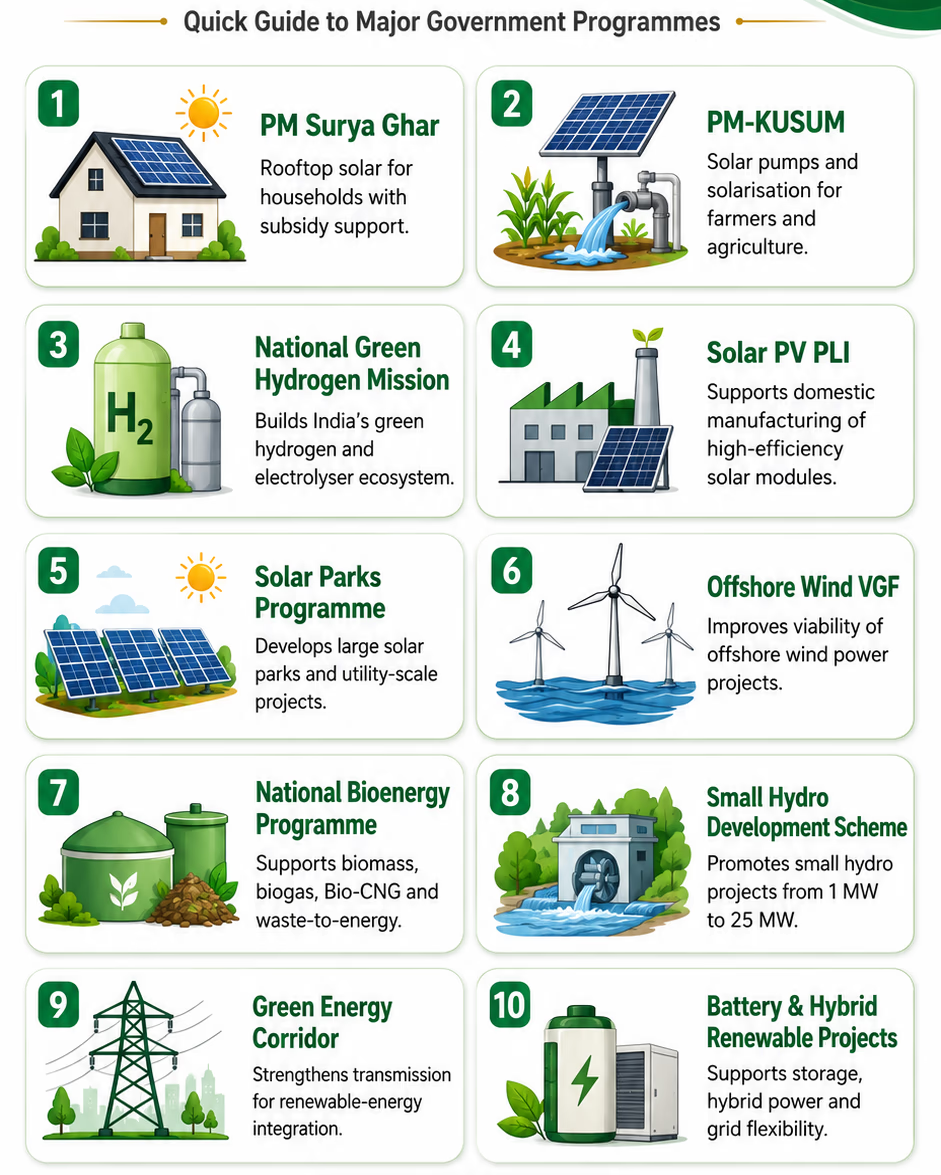
Major Green-Energy Government Schemes in India
India has several programmes covering different segments of the renewable-energy economy.
Some programmes are aimed at households, some at farmers, while others are designed for manufacturers, utilities or large project developers.
1. PM Surya Ghar: Muft Bijli Yojana
PM Surya Ghar is one of India's most important residential renewable-energy programmes.
The scheme promotes rooftop solar installations for residential households and provides Central Financial Assistance subject to the applicable guidelines.
MNRE has issued detailed guidelines covering residential consumers, DISCOM incentives, local bodies, model solar villages, capacity building and other components.
How it works
A household can install an eligible rooftop solar system and obtain financial assistance according to the applicable scheme rules.
The process typically involves:
Consumer → PM Surya Ghar Portal → DISCOM/Vendor → Rooftop Installation → Verification → Subsidy/CFA
The system can generate electricity for household consumption, thereby potentially reducing electricity purchased from the grid.
2. PM-KUSUM: Solar Energy for Agriculture
The Pradhan Mantri Kisan Urja Suraksha evam Utthaan Mahabhiyan (PM-KUSUM) has been one of India's major programmes linking renewable energy with agriculture.
MNRE describes three main components of PM-KUSUM.
Component A
Development of decentralized ground-mounted or stilt-mounted grid-connected renewable-energy power plants.
Component B
Installation of standalone solar agricultural pumps.
Component C
Solarization of grid-connected agricultural pumps, including relevant feeder-level arrangements under the applicable framework.
The programme targeted 34,800 MW of additional solar capacity with total Central Financial Support of ₹34,422 crore under its announced structure.
The PM-KUSUM portal also carried subsequent implementation and timeline-related clarifications during 2026, meaning applicants should check the latest status applicable to their state and component rather than relying only on the original programme dates.
3. National Green Hydrogen Mission
Green hydrogen could become one of the largest emerging areas of India's future energy economy.
Green hydrogen is generally produced by using renewable electricity to split water through electrolysis, resulting in hydrogen production without the conventional fossil-fuel-intensive production process.
India's National Green Hydrogen Mission has an announced outlay of ₹19,744 crore and aims to develop a domestic green-hydrogen ecosystem. MNRE states a target of at least 5 million metric tonnes of annual green-hydrogen production capacity.
The mission includes areas such as:
Electrolyze manufacturing
Green-hydrogen production
SIGHT incentives
Hydrogen hubs
Research and development
Pilot projects
Skills development
Hydrogen transport and distribution infrastructure
MNRE has separately issued programme guidelines covering hydrogen hubs, electrolyser manufacturing, R&D and skills development.
4. Solar PV Manufacturing and the PLI Programme
India's green transition requires not only renewable-energy generation but also domestic manufacturing capacity.
The government has introduced the Production Linked Incentive Scheme for High Efficiency Solar PV Modules to support domestic manufacturing and reduce dependence on imported equipment.
MNRE states that the programme is aimed at developing an ecosystem for manufacturing high-efficiency solar PV modules in India.
Such projects can involve:
5. Solar Parks and Large Solar Projects
India has also promoted the development of large solar parks.
The Solar Parks and Ultra Mega Solar Power Projects programme had its capacity objective increased from 20,000 MW to 40,000 MW.
Large solar parks can provide common infrastructure needed by multiple solar developers.
Unlike a small rooftop installation, utility-scale solar projects can involve project costs running into hundreds or thousands of crores.
6. Wind Energy and Offshore Wind
India already has a significant onshore-wind industry and is developing frameworks for offshore wind.
Offshore wind turbines can potentially generate significant renewable electricity but involve much higher development and infrastructure costs.
The government has issued a Viability Gap Funding Scheme for Offshore Wind Energy Projects.
Under one development model described by MNRE, Central Financial Assistance in the form of VGF can help support predetermined power tariffs.
7. National Bioenergy Programme
Green energy does not mean only solar and wind.
India also has significant biomass, agricultural-residue, biogas and waste-to-energy potential.
The first phase of the National Bioenergy Programme covered:
MNRE had notified Phase I for the period from April 2021 through March 2026.
The government's BioUrja portal indicates that some new proposals are linked to approval and funding arrangements for the subsequent phase, so businesses should verify the current programme status before calculating any expected subsidy.
Projects That Can Fall Within the Bioenergy Ecosystem
Examples include:
Biomass pellet manufacturing
Biomass briquettes
Biogas plants
Bio-CNG/CBG projects
Waste-to-energy
Agricultural-residue processing
Biomass-based cogeneration
These projects can provide both an environmental and an economic benefit by converting waste or agricultural residue into usable energy.
8. Small Hydro Power
Small hydro is another segment of India's renewable-energy portfolio.
In May 2026, MNRE issued administrative approval for the Small Hydro Power Development Scheme covering projects from 1 MW to 25 MW for FY2026-27 through FY2030-31.
This is particularly relevant because it represents a newer programme period extending beyond many schemes whose earlier phases ended in March 2026.
9. Green Energy Corridor
Generating renewable electricity is only one part of the solution.
Electricity also has to reach consumers.
Large renewable-energy capacity located in solar- and wind-rich areas requires transmission infrastructure.
India's Green Energy Corridor programme has therefore focused on strengthening transmission infrastructure for renewable-energy integration. MNRE continues to maintain the programme and related policy framework.
Infrastructure can include:
10. Battery Energy Storage Systems
Solar and wind power are variable.
Solar panels produce electricity primarily during daylight hours, while wind generation depends upon wind conditions.
Energy-storage systems can store electricity and release it when required.
Battery Energy Storage Systems, or BESS, can therefore support:
Renewable-energy integration
Peak-demand management
Grid stability
Round-the-clock renewable-power arrangements
Renewable hybrid projects
Storage is becoming an increasingly important component of India's energy transition.
11. Wind-Solar Hybrid Projects
A hybrid renewable project combines more than one source of renewable generation.
A common example is:
Solar + Wind + Optional Battery Storage
Solar and wind generation profiles can complement each other, potentially improving utilisation of transmission infrastructure.
Banks financing hybrid projects evaluate many of the same risks as other renewable-energy projects but must also understand generation modelling across multiple technologies.
How Indian Banks Are Supporting the Green-Energy Transition
Government subsidies alone cannot fund India's renewable-energy expansion.
The financial system plays an essential role.
Broadly, green financing takes place through several channels.
1. Retail Green Loans
Banks can finance smaller projects such as:
This creates an opportunity to incorporate green financing into retail banking.
2. Agricultural Renewable-Energy Finance
Solar pumps and decentralised renewable-energy projects can combine agricultural lending with energy financing.
PM-KUSUM is a major example.
Banks may finance eligible beneficiary contributions based on scheme conditions and borrower creditworthiness.
3. MSME Green Finance
MSMEs can require funding for:
Rooftop solar
Energy-efficiency improvements
Biomass equipment
Renewable manufacturing
Captive renewable projects
Waste-to-energy equipment
An MSME that reduces electricity costs may improve its operating economics, although the bank still needs to evaluate whether the investment produces sufficient financial benefits.
4. Corporate Renewable-Energy Finance
Larger companies may borrow for:
Captive solar plants
Open-access renewable projects
Renewable procurement infrastructure
Battery storage
Green manufacturing
Energy-efficiency upgrades
For corporations, green investment is increasingly becoming part of overall capital-expenditure planning.
5. Renewable-Energy Project Finance
Large renewable projects are often financed based substantially on the project's future cash flows.
The bank therefore evaluates the project's ability to service debt rather than relying only on the promoter's existing business.
Typical ratios and metrics include:
Debt-Equity Ratio
Debt ÷ Equity
Debt Service Coverage Ratio
Cash Available for Debt Service ÷ Debt Obligations
Project IRR
Measures the expected return generated by the project.
Equity IRR
Measures returns to equity investors.
Capacity Utilisation Factor
Important for estimating renewable electricity generation.
Break-even Analysis
Measures the level at which project revenues cover relevant costs.
How bankers should assess renewable-energy proposals.
Renewable Energy and Priority Sector Lending
Renewable energy is recognised as a category within the Reserve Bank of India's Priority Sector Lending framework.
RBI's priority-sector framework includes renewable energy alongside categories such as agriculture, MSMEs, housing and social infrastructure.
Whether a particular renewable-energy loan qualifies for priority-sector classification depends on the applicable RBI directions, borrower, activity, exposure and other conditions.
Therefore:
A project being "green" does not automatically mean every loan made to it qualifies as priority-sector lending.
Banks must check eligibility under the prevailing RBI guidelines.
This regulatory classification can nevertheless support credit flow into eligible renewable-energy activities.
IREDA: A Specialist Green-Energy Financier
One of India's most important institutions in renewable-energy finance is the Indian Renewable Energy Development Agency Limited (IREDA).
IREDA is a Navratna Central Public Sector Enterprise under MNRE and provides financing across renewable-energy sectors.
Its financing areas include solar, wind, hydro, transmission, biomass, waste-to-energy, ethanol, CBG and emerging clean-energy technologies.
IREDA's lending activity illustrates the scale of India's green-financing market.
For FY2025-26, IREDA reported provisional loan sanctions of approximately ₹51,883 crore, its highest annual sanctions at that point.
IREDA also maintains specialised financing schemes and lending products for renewable-energy projects.
What Does a Bank Examine Before Financing a Green Project?
A government subsidy does not automatically make a project bankable.
Banks still need to establish the borrower's and project's repayment capability.
A lender may assess the following.
1. Promoter Background
Experience
Financial position
Credit history
Existing liabilities
Management capability
2. Project Cost
The project cost must be realistic and supported by quotations and technical information.
3. Means of Finance
The bank establishes how the project will be funded.
For example:
Source | Amount |
|---|
Promoter contribution | ₹20 lakh |
Eligible subsidy/CFA | ₹30 lakh |
Bank term loan | ₹50 lakh |
Total project cost | ₹1 crore |
This is only an illustration.
Actual scheme structures vary.
4. Technical Feasibility
The lender may examine:
Technology
Supplier
Capacity
Equipment warranties
Generation estimates
Site suitability
5. Economic Viability
The bank evaluates whether the project makes economic sense.
6. Cash-Flow Viability
Projected cash flows must ordinarily be capable of meeting operating expenses and loan repayments.
7. Security
Depending on the lender and loan programme, banks may consider:
8. Government Approvals
Large projects may require multiple permissions and clearances.
9. Power Purchase Agreement
For electricity-generating projects, the lender needs to understand who will purchase the power and the applicable commercial arrangement.
Government Subsidy Does Not Guarantee Bank Loan Approval
This is an important distinction for borrowers.
Suppose a government programme provides financial assistance for a solar project.
That does not necessarily mean a bank must approve the remaining financing.
A bank can still evaluate:
Therefore:
Government Scheme Eligibility ≠ Automatic Loan Eligibility
Both must usually be satisfied independently.
Key Government Programmes at a Glance
Programme | Main Area | Typical Beneficiary/Project |
|---|
PM Surya Ghar | Rooftop solar | Households |
PM-KUSUM | Solar agriculture | Farmers/developers |
National Green Hydrogen Mission | Green hydrogen | Industrial/project developers |
Solar PV PLI | Solar manufacturing | Manufacturers |
Solar Parks Programme | Utility-scale solar | Developers/states |
Offshore Wind VGF | Offshore wind | Large developers |
National Bioenergy Programme | Biomass/biogas/WtE | Businesses/developers |
Small Hydro Development Scheme | Small hydro | Project developers |
Green Energy Corridor | Transmission | Utilities/infrastructure |
Energy Storage initiatives | Battery/storage | Developers/utilities |
Scheme availability and implementation periods differ, so this table should be treated as an overview rather than a substitute for individual scheme guidelines.
Conclusion
India's green-energy transition is creating opportunities for households, farmers, businesses, manufacturers, renewable-energy developers and financial institutions.
Government programmes such as PM Surya Ghar, PM-KUSUM, the National Green Hydrogen Mission, solar-manufacturing incentives, offshore-wind support, bioenergy programmes, the Small Hydro Power Development Scheme and transmission initiatives such as the Green Energy Corridor address different parts of the energy transition.
But government support is only one side of the equation.
Banks and financial institutions provide the capital required to convert policy objectives into operating assets.
For a household, that may mean financing rooftop solar.
For a farmer, it may mean financing a solar pump.
For an MSME, it may mean funding a captive renewable-energy system.
For a large developer, it may involve sophisticated project finance worth hundreds or thousands of crores.
That makes green energy increasingly relevant not only as an environmental subject but also as a banking, credit, investment and infrastructure-finance opportunity.
As India's renewable-energy ecosystem expands, understanding how government incentives interact with bank finance will become increasingly important for borrowers, bankers and investors alike.
Disclaimer: This article is for educational and informational purposes only. Government schemes, subsidies, financing terms, interest rates, eligibility criteria and regulatory provisions are subject to change. Readers should verify the latest information with MNRE, RBI, IREDA, the relevant DISCOM/state nodal agency and their lender before taking any financial or investment decision.