India GDP Growth Forecasts: How ADB, IMF, and World Bank Calculate Them
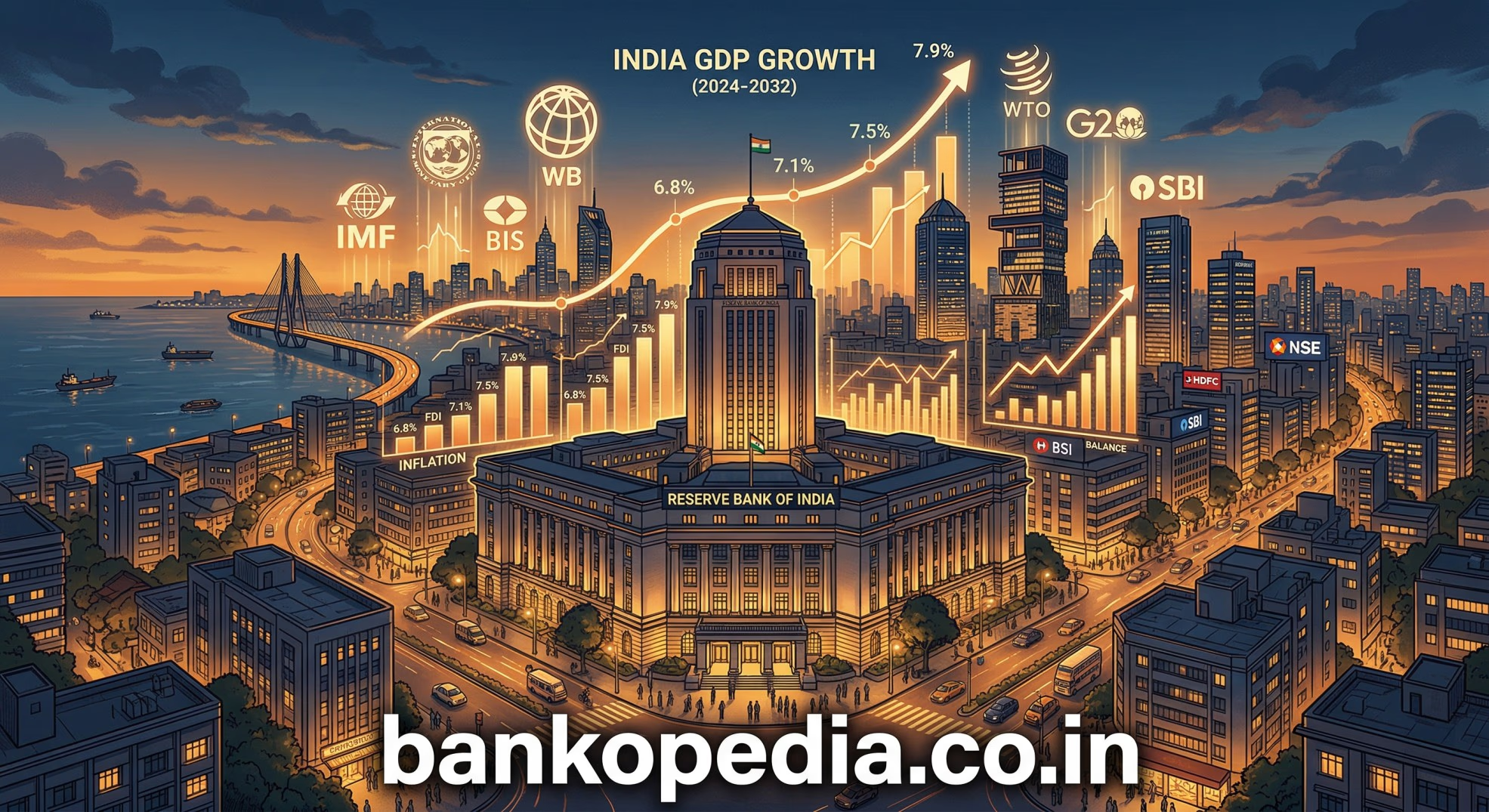
Every quarter, headlines trumpet revisions — upward or downward — to India's projected GDP growth rate from institutions like the Asian Development Bank (ADB), the International Monetary Fund (IMF), and the World Bank. Most recently, the ADB raised its forecast for India's FY27 growth to 6.9%, reinforcing India's position as one of the fastest-growing major economies in the world. Yet few banking professionals, investors, or even seasoned policymakers pause to ask the more fundamental question: how exactly are these numbers derived, and how much should we rely on them? Understanding the India GDP growth forecast ADB IMF methodology is not merely an academic exercise — it has direct implications for investment decisions, credit policy, monetary strategy at the Reserve Bank of India (RBI), and sectoral planning across banking and financial services. This article demystifies the mechanics behind these forecasts and offers a framework for interpreting them responsibly.
Who Are the Major Institutions That Forecast India's GDP Growth?
Before examining methodology, it is important to understand the institutional landscape. Several multilateral and bilateral agencies publish regular GDP growth projections for India, each with a distinct mandate, analytical framework, and publication calendar.
The Asian Development Bank (ADB)
The ADB publishes its flagship Asian Development Outlook (ADO) twice a year, with supplementary updates in between. As a Manila-based multilateral development bank with India as one of its largest borrowers and shareholders, the ADB maintains a dedicated India Resident Mission that feeds ground-level data into its macroeconomic models. The ADB's projections tend to be granular on South and Southeast Asian economies, giving its India forecasts particular credibility in regional contexts.
The International Monetary Fund (IMF)
The IMF publishes its World Economic Outlook (WEO) in April and October, with interim updates in January and July. The IMF also conducts annual Article IV Consultations with member countries — including India — where its staff engages directly with the Ministry of Finance, RBI, SEBI, and other regulators. These consultations result in a Staff Report that often contains the most detailed analytical assessment of India's macroeconomic risks and prospects.
The World Bank
The World Bank releases its Global Economic Prospects report biannually and maintains country-specific economic updates. Its focus tends to blend macroeconomic analysis with development indicators — poverty reduction, infrastructure spending, financial inclusion — making its forecasts particularly relevant for understanding the distributional aspects of growth.
Domestic Forecasters
It is worth noting that India's own institutions also publish authoritative projections. The RBI's Monetary Policy Committee (MPC) publishes GDP growth forecasts in every bi-monthly Monetary Policy Report. The National Statistical Office (NSO) publishes advance estimates, and NITI Aayog contributes medium-term projections. The RBI Bulletin's Weekly Statistical Supplement, a key data reference, provides the raw economic indicators — including India's forex reserves, which recently rose by $9.06 billion to $697.12 billion for the week ending April 3 — that feed into both domestic and international forecasting models.
What Methodology Does ADB Use to Project India's Economic Growth?
The India GDP growth forecast ADB IMF methodology is rooted in a combination of macroeconomic modelling, high-frequency data tracking, and qualitative judgement from country economists. While each institution has proprietary models, certain core methodological pillars are broadly shared.
1. Expenditure-Side GDP Decomposition
All three institutions begin with the standard national accounts framework. India's GDP from the expenditure side is decomposed into:
Private Final Consumption Expenditure (PFCE) — the largest component, typically accounting for about 57–60% of GDP
Government Final Consumption Expenditure (GFCE)
Gross Fixed Capital Formation (GFCF) — a proxy for investment activity
Net Exports — exports minus imports
Changes in Inventories
Forecasters build separate sub-models for each component and then aggregate them. For instance, the ADB's India team would model private consumption using variables like real household income growth, Consumer Price Index (CPI) inflation, and consumer confidence surveys.
2. Structural Macroeconometric Models
The IMF uses a suite of models including the Global Integrated Monetary and Fiscal Model (GIMF) and the Flexible System of Global Models (FSGM). These are dynamic general equilibrium frameworks that account for cross-country trade and financial linkages — critical when assessing how a US Federal Reserve rate hike or a Chinese demand slowdown ripples into Indian growth projections.
The ADB uses its own regional model but also relies extensively on reduced-form econometric models calibrated specifically to Asian economies. These models incorporate India-specific structural features: the dominance of domestic consumption, the sensitivity of agriculture to monsoon patterns, and the outsized role of services in GDP.
3. High-Frequency Indicator Tracking
Model outputs are continuously cross-checked against high-frequency indicators. For India, these typically include:
Purchasing Managers' Index (PMI) — both manufacturing and services
GST collections — a real-time proxy for formal economic activity
Credit growth data from the RBI's sectoral deployment of bank credit reports
Index of Industrial Production (IIP)
Electricity consumption and fuel sales
Foreign exchange reserves and trade data
Capital flows — FDI and FPI data from SEBI and RBI
The RBI's VRRR (Variable Rate Reverse Repo) auctions — such as the recently announced ₹2 lakh crore 7-day VRRR auction — serve as signals of system liquidity conditions, which in turn influence credit growth projections used by international forecasters monitoring India's monetary stance.
4. Assumptions and Scenario Construction
A crucial but often under-appreciated aspect of GDP forecasting is the role of explicit assumptions. Every forecast is conditional on a set of baseline assumptions, including:
Global commodity prices, especially crude oil — critical for a net importer like India
Monsoon performance, given agriculture's linkage to rural incomes and inflation
The trajectory of the US dollar and its impact on the Indian rupee
Fiscal policy stance — particularly the capital expenditure trajectory of the Union Budget
Monetary policy — RBI's repo rate path and its transmission to lending rates
When any of these assumptions change materially — say, crude oil prices spike following a geopolitical event, or the monsoon is deficient — institutions revise their forecasts at the next scheduled publication window, or issue off-cycle updates if the shock is severe enough.
5. The Role of Article IV Consultations and Country Missions
Both the IMF and ADB conduct country missions where their economists meet with officials from the Ministry of Finance, the RBI, SEBI, NABARD, and other regulatory bodies. These consultations provide qualitative context that pure data modelling cannot capture — for instance, the intent and feasibility of a specific capital expenditure commitment, or the likely impact of a proposed regulatory change such as the RBI's recent proposal to include PSUs in the upper-layer NBFC framework. Such policy signals are factored into the judgement overlays that economists apply on top of model outputs.
Key Indicators That Drive Upward or Downward Revisions in Forecasts
Understanding what causes these institutions to revise their India growth forecasts up or down is arguably more useful than knowing the point estimate itself. Revisions are not arbitrary — they follow a discernible logic.
Factors Leading to Upward Revisions
Stronger-than-expected government capex execution: When Union Budget capital expenditure allocations are actually disbursed — rather than remaining on paper — it has a strong multiplier effect on construction, manufacturing, and ancillary services.
Robust credit growth: Sustained double-digit credit growth, particularly in retail, MSME, and infrastructure segments, signals strong investment and consumption momentum.
Favourable monsoon: An above-normal monsoon boosts agricultural output, rural incomes, and consequently rural consumption — a segment that moves the needle on aggregate demand significantly.
Strong GST collections: Consistently high GST revenues signal buoyant economic activity in the formal sector and also reduce fiscal consolidation pressure.
Improving forex reserve buffers: India's forex reserves touching $697.12 billion signal external sector resilience, reducing the probability of a balance-of-payments shock that could derail growth.
Factors Leading to Downward Revisions
Global demand slowdown: A recession in the US or EU reduces demand for Indian IT services exports and merchandise, directly denting the services and goods export components of GDP.
Elevated domestic inflation: Persistent CPI inflation forces the RBI to maintain restrictive monetary policy, dampening credit growth and private investment.
Geopolitical shocks: Disruptions to global supply chains or energy markets — particularly crude oil price spikes — worsen India's terms of trade and compress corporate margins.
NBFC sector stress: Given NBFCs' critical role in last-mile credit delivery — particularly through NABARD-supervised microfinance channels — any systemic stress in the sector can disrupt credit flow to agriculture and MSMEs, dragging down growth projections.
Fiscal slippage: If the government's fiscal deficit widens beyond comfort zones, it crowds out private investment and may prompt rating outlook changes that tighten external borrowing conditions.
The Uncertainty Bands Around Point Estimates
A 6.9% growth forecast from the ADB is not a precise prediction — it is the central value in a probability distribution. The IMF, to its credit, publishes explicit fan charts and scenario analyses in its WEO that illustrate downside and upside risks. For India's FY27 forecast, one could reasonably construct a scenario range of 6.2% to 7.4% depending on global and domestic conditions. Banking and finance professionals should always read the risk sections of these reports, not just the headline number.
"A GDP forecast without its confidence interval is like a loan assessment without a stress test — it gives you comfort without clarity."
How Should Investors and Policymakers Use GDP Forecasts Responsibly?
The real value of understanding the India GDP growth forecast ADB IMF methodology lies in its application. Both the investment community and policymakers routinely misuse these forecasts — either over-relying on them as precise predictions or dismissing them as politically motivated.
For Investors and Portfolio Managers
GDP growth forecasts should not be used as direct inputs for equity valuation or fixed income positioning in isolation. Instead, they serve best as:
Directional signals: A sustained upward revision trend (as we are seeing with India relative to peers) is a qualitative signal of improving macro fundamentals, warranting a positive tilt toward India-heavy emerging market portfolios.
Sector allocation guides: A growth forecast driven primarily by private capex and infrastructure spending — as reflected in recent ADB assessments — favours capital goods, construction, and banking stocks over purely consumption-driven plays.
Interest rate trajectory hints: If forecasters are simultaneously projecting higher growth and lower inflation for India, it creates space for RBI rate cuts, which is bullish for duration-sensitive bond positions and rate-sensitive sectors like housing finance companies (HFCs) and vehicle financiers.
Currency positioning: Strong growth forecasts, combined with healthy forex reserves, generally support rupee stability — relevant for importers, exporters, and foreign institutional investors (FIIs) managing currency-hedged positions.
For Banking and Financial Institutions
For credit risk teams at banks and NBFCs, GDP growth forecasts serve as a macro overlay on loan portfolio stress testing. A projected growth deceleration below 6% would typically trigger a review of provisions for sectors most sensitive to the economic cycle — real estate, construction, and discretionary retail lending. Conversely, sustained 6.5–7% growth supports asset quality improvement across the board.
The RBI itself uses GDP growth projections in its monetary policy deliberations. The MPC's forward guidance on the repo rate is explicitly conditioned on its own growth and inflation projections. When ADB or IMF projections diverge significantly from RBI projections, it warrants examination — the methodological or assumption differences often reveal important nuances about India's economic outlook.
For Policymakers
For the Ministry of Finance, NITI Aayog, and sectoral regulators, multilateral forecasts serve three distinct purposes. First, they provide external validation — or challenge — of the government's own growth assumptions embedded in budget arithmetic. Second, they serve as diplomatic and market communication tools — a positive ADB or IMF forecast revision enhances India's sovereign credit narrative globally. Third, the risk scenarios in these forecasts flag specific vulnerabilities that require policy attention — whether it is the current account deficit, rural distress, or NBFC sector resilience.
The Limits of Forecasting: What These Numbers Cannot Tell You
It is equally important to acknowledge what GDP growth forecasts do not capture. A 6.9% headline growth rate says nothing about income distribution, the quality of employment generated, the environmental cost of growth, or the financial inclusion gap. For a country where NABARD estimates that over 40% of rural households still have limited access to formal credit, the GDP aggregate can mask significant structural vulnerabilities. IRDAI's efforts to deepen insurance penetration and SEBI's push to expand capital market participation are as important to India's economic resilience as the headline growth number itself.
Conclusion: Reading Between the Lines of a Growth Forecast
The ADB's upgrade of India's FY27 growth forecast to 6.9% is a positive signal, but its true value lies not in the number itself but in understanding the analytical machinery behind it. From expenditure-side decomposition and macroeconometric modelling to high-frequency indicator tracking and policy consultation missions, these forecasts represent a sophisticated synthesis of data and judgement. India's strengthening forex buffers, improving fiscal consolidation trajectory, and evolving regulatory architecture — including the RBI's calibrated interventions in money markets and the NBFC regulatory tightening — all feed into the narrative that international forecasters are pricing in.
For Indian banking and finance professionals, the right approach is to treat GDP forecasts as informed starting points for analysis, not endpoints. Read the methodology appendices. Study the risk scenarios. Track the high-frequency indicators that these institutions themselves monitor. And always ask: what would have to go wrong — or right — for this number to change materially? That question, more than the point estimate itself, is where genuine financial insight begins.

