What Is a Universal Bank Licence in India?
A universal bank in India is a fully licensed scheduled commercial bank authorised to offer the complete and unrestricted spectrum of banking and financial services to all conceivable categories of customers. This includes retail individuals, micro-enterprises, small and medium enterprises (SMEs), large-cap corporate houses, multinational conglomerates, and government entities.
Unlike niche or differentiated financial institutions—such as Small Finance Banks (SFBs), Payments Banks, or Regional Rural Banks (RRBs)—a universal bank operates without any statutory sectoral restrictions on its lending operations. It has no mandatory caps on loan ticket sizes, no geographic limitations within the country, and possesses the authority to raise demand and time deposits from the general public without any upper-limit constraints on account balances.
Universal banks in India are primarily regulated under the Banking Regulation Act, 1949, and the Reserve Bank of India Act, 1934. They must maintain strict and continuous compliance with all RBI prudential norms. These overarching regulatory requirements include:
Cash Reserve Ratio (CRR): A specified fraction of the total net demand and time liabilities (NDTL) that the bank must hold as liquid cash reserves with the RBI.
Statutory Liquidity Ratio (SLR): A mandatory reserve requirement obligating banks to maintain a certain percentage of their NDTL in the form of liquid assets, such as unencumbered government securities, gold, or other approved instruments.
Basel III Capital Adequacy Norms: Stringent global regulatory standards designed to ensure banks maintain adequate capital cushions to absorb potential economic shocks and credit losses.
Priority Sector Lending (PSL) Requirements: A mandate ensuring that a specific portion of the bank's lending is directed toward vital, under-represented sectors of the economy, such as agriculture, micro-enterprises, education, housing, and weaker societal sections.
The universal bank category encompasses India's largest, most systemically important, and established financial institutions. This includes public sector giants like the State Bank of India (SBI) and Bank of Baroda, as well as leading private sector entities such as HDFC Bank, ICICI Bank, Axis Bank, Kotak Mahindra Bank, and IndusInd Bank.
Equipped with a universal banking licence, these institutions possess the broad authority to:
Accept demand deposits (current and savings accounts) and term deposits (fixed and recurring deposits) without any monetary ceilings.
Extend credit and specialized financing across all sectors, including massive corporate syndications, retail mortgages, agricultural credit, and long-term infrastructure project financing.
Offer highly specialized investment banking, corporate advisory, and wealth management services.
Engage in domestic and international foreign exchange (forex) operations, cross-border remittances, and complex treasury services including derivative trading.
Distribute third-party financial products such as mutual funds, life insurance, and general insurance (acting as corporate agents).
Participate heavily in domestic interbank money markets and act as primary dealers or active participants in government securities markets.
Operate through an entirely unrestricted branch and automated teller machine (ATM) network across metropolitan, urban, semi-urban, and rural centers nationwide, subject to broad RBI branching guidelines.
The RBI has historically opened licensing windows for new universal banks sparingly to prevent overcrowding and ensure systemic stability. Notable rounds occurred in 1993, 2001, and 2013–14 (when IDFC Bank and Bandhan Bank successfully received in-principle approvals). In a major paradigm shift in August 2016, the RBI issued guidelines for "on-tap" licensing of universal banks in the private sector. This framework enabled eligible, thoroughly vetted entities to submit applications at any time of the year, rather than waiting for the RBI to announce a specific, time-bound licensing round.
RBI Eligibility Criteria for Universal Bank Licence (Updated Guidelines)
The RBI has laid out highly explicit, non-negotiable eligibility norms under its "Guidelines for 'on tap' Licensing of Universal Banks in the Private Sector," which have been updated periodically to reflect changing economic realities. In 2021, following the recommendations of an Internal Working Group (IWG), the RBI made significant structural enhancements to these requirements, particularly concerning capital thresholds.
These criteria are exceptionally demanding and multidimensional. They assess an applicant's sheer financial capacity, complex ownership structures, historical experience in managing risk, and unblemished regulatory standing.
1. Eligible Applicant Entities
The RBI strictly gates who may even initiate an application. The regulator permits only the following categories of entities to apply for a new universal bank licence:
Resident individuals and seasoned professionals possessing at least ten years of proven experience in banking and finance at a senior management level.
Entities and enterprise groups in the private sector—both within the financial and non-financial business space—provided they are owned and controlled by Indian residents and have a successful, unblemished track record spanning at least ten years. (Note: Large industrial houses are generally not permitted to promote universal banks, though they may hold up to a 10% equity stake as portfolio investors).
Existing Non-Banking Financial Companies (NBFCs) that are controlled by residents and have a successful track record of at least ten years.
Existing Small Finance Banks (SFBs) that meet prescribed operational and performance milestones, actively seeking to voluntarily transition into a universal banking model.
2. Minimum Capital Requirement (The ₹1,000 Crore Mandate)
Critical Update: Originally set at ₹500 crore in the 2016 guidelines, the RBI officially raised the capital threshold in late 2021 to ensure banks have stronger resilience against macroeconomic shocks and can invest in robust technological infrastructure from day one.
Currently, the promoter group must bring in a minimum paid-up voting equity capital and maintain a minimum net worth of ₹1,000 crore at the time of the commencement of the banking business. This financial threshold is strictly non-negotiable. Furthermore, the bank must maintain a minimum capital adequacy ratio (CRAR) of 13% for the first three years of its operations.

3. Promoter Shareholding and the 5-Year Lock-In Rule
The RBI enforces rigorous ownership rules to ensure "skin in the game" during the bank's vulnerable formative years, while also enforcing long-term ownership diversification to prevent concentrated risk.
The 5-Year Lock-In: The promoters of the new bank are legally required to hold a minimum of 40% of the paid-up voting equity capital of the bank, and this entire 40% stake must be locked in for a period of exactly five years from the date of commencement of the banking business.
The 15-Year Cap: To prevent undue long-term influence by a single entity over a systemically important institution, the promoter's shareholding must eventually be diluted and capped at a maximum of 26% of the paid-up voting equity capital by the end of 15 years of operations. Promoters are required to submit a clear, viable dilution schedule to the RBI outlining how they will achieve this structural transition.
4. Corporate Structure: Non-Operative Financial Holding Company (NOFHC)
If the applicant is a standalone individual or an entity without other financial or commercial group companies, an intermediate holding structure is not strictly required. However, if the applicant is part of a broader corporate conglomerate that owns other financial or non-financial businesses, the bank must be set up and held through a Non-Operative Financial Holding Company (NOFHC).
The NOFHC is a critical regulatory mechanism designed to ring-fence the bank. It isolates depositor funds from the operational risks, liabilities, and potential contagion of affiliated group entities. The NOFHC must be wholly owned by the promoter group, and it must hold the bank as well as all other regulated financial services entities of the group, ensuring total transparency in corporate governance and consolidated supervision by the RBI.
5. The "Fit and Proper" Assessment
Promoters, major shareholders, and proposed directors must pass the RBI's legendary "fit and proper" standards—an exhaustive integrity, competence, and background test. This qualitative assessment evaluates:
A clean operational history with an absolute absence of criminal records or pending prosecutions for financial fraud, money laundering, or economic offenses.
No adverse regulatory history, censures, or penalties imposed by the RBI, the Securities and Exchange Board of India (SEBI), the Insurance Regulatory and Development Authority of India (IRDAI), the Enforcement Directorate (ED), or the National Bank for Agriculture and Rural Development (NABARD).
A deeply demonstrated, empirically verifiable track record of sound financial management and ethical business conduct.
6. Business Plan and the Financial Inclusion Mandate
Applicants are required to submit a highly credible, meticulously detailed, and data-backed five-year business plan. Crucially, this plan must demonstrate how the proposed bank will contribute meaningfully to financial inclusion—a core, non-negotiable policy priority of the RBI and the Government of India. The RBI explicitly rejects applications that merely seek to replicate existing urban-centric commercial banking models. The business plan must articulate differentiated value, robust technological integration, and a clear strategy for serving unbanked and underbanked populations. Furthermore, the bank must commit to opening at least 25% of its branches in unbanked rural centers.
7. Foreign Direct Investment (FDI) and Shareholding Limits
The aggregate non-resident shareholding in a newly licensed private sector bank is subject to India's overarching FDI policy for the banking sector.
The accurate framework is as follows: Foreign investment in private sector banks is permitted up to a maximum aggregate cap of 74%. However, this is split into two distinct approval routes:
Foreign investment up to 49% is permitted under the Automatic Route (meaning it does not require prior government approval, provided all other regulatory filings are met).
Any foreign investment beyond 49% and up to the maximum cap of 74% requires strict clearance under the Government Approval Route.
Regardless of foreign participation, majority control and strategic management must effectively rest with domestic stakeholders and compliant resident promoters.
Step-by-Step Application and Evaluation Process
The RBI's evaluation of a universal bank licence application is notoriously methodical, incredibly multi-layered, and deliberately unhurried. The central bank places institutional stability and the safety of the Indian depositor above speed and corporate convenience. Applicants should fully expect the process to span several years from the initial submission to the final grant of the licence.
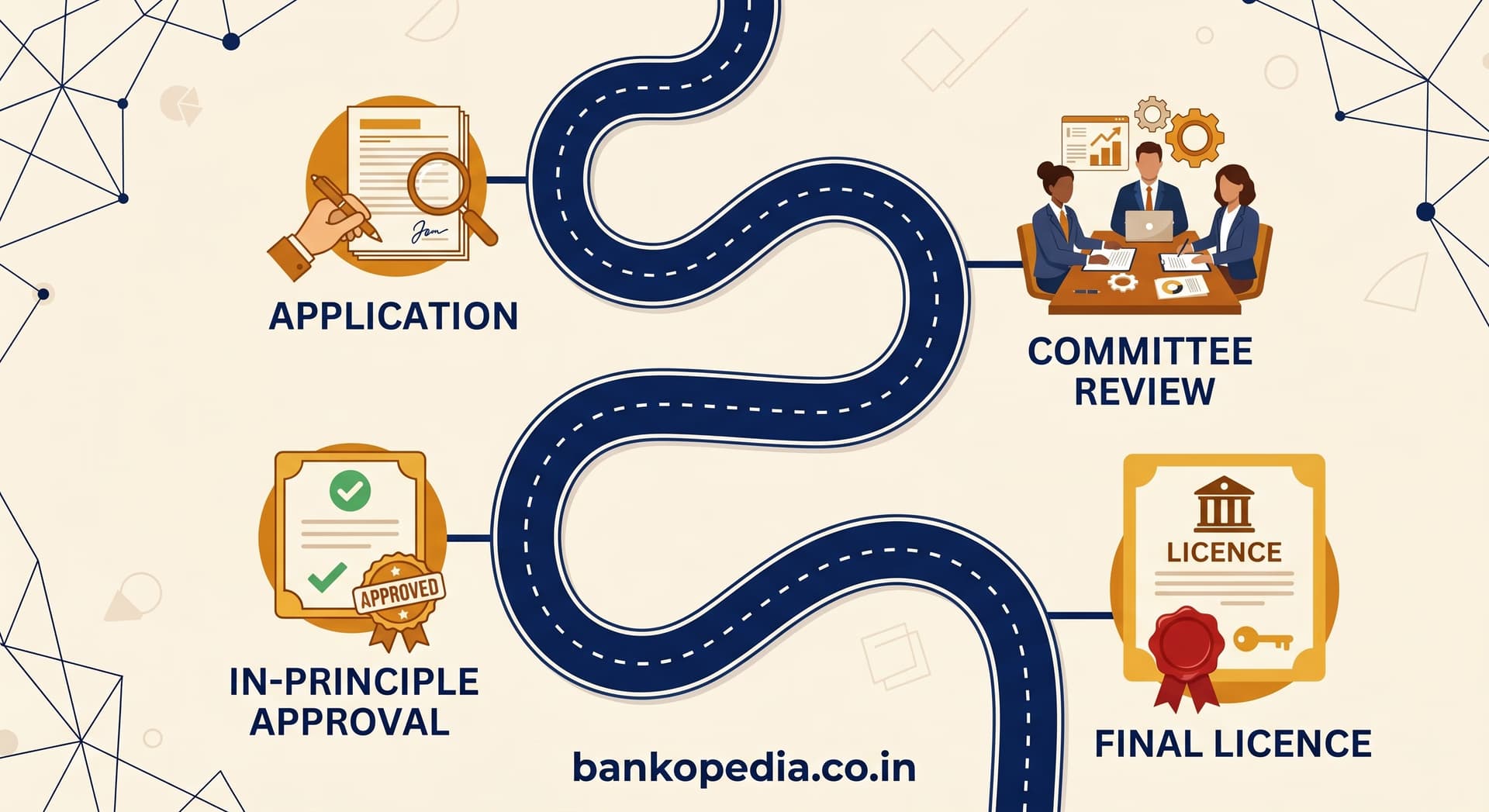
Step 1: Formal Submission of the Application
Under the modern on-tap licensing framework, applications are submitted to the Department of Regulation at the RBI Central Office in Mumbai. Recently, the RBI has also mandated the use of its unified PRAVAAH (Platform for Regulatory Application, Validation And Authorisation) portal to streamline submissions. The application dossier must include the applicant's detailed background, the proposed corporate governance framework, projected capital adequacy ratios under stress-test scenarios, the financial inclusion strategy, and audited financial statements for the past five years.
Step 2: Initial RBI Screening
Upon receipt, internal RBI departments conduct a rigorous preliminary review. This stage checks whether the application is administratively complete and whether the applicant meets the fundamental, non-negotiable eligibility thresholds (like the ₹1,000 crore net worth). Incomplete applications, or those clearly falling short of basic metrics, are returned at this stage to prevent the wastage of regulatory resources.
Step 3: Reference to the Standing External Advisory Committee (SEAC)
Applications that survive the initial internal scrutiny are formally referred to a Standing External Advisory Committee (SEAC) constituted by the RBI. This elite committee typically comprises highly eminent individuals from the worlds of banking, finance, economics, and regulation—often including former deputy governors of the RBI, renowned economists, veteran legal experts, and seasoned sector specialists. The SEAC evaluates the application purely on its substantive merit. They analyze the promoter's historical track record, the viability of the business plan in the current macroeconomic climate, and the robustness of the proposed governance architecture. The SEAC's recommendations are advisory in nature, but they carry immense, often decisive, weight in the final outcome.
Step 4: Comprehensive Internal Evaluation and Intelligence Gathering
Simultaneously, the RBI's internal machinery kicks into high gear. The Department of Regulation, the Department of Supervision, and specialized risk units conduct independent, granular assessments. Crucially, intense background verification of the promoters and proposed key management personnel is undertaken. This involves covert and overt collaboration with national intelligence agencies, the Financial Intelligence Unit (FIU), and other financial regulators. SEBI's inputs are heavily scrutinized if the promoters have exposure to capital markets; IRDAI is consulted if insurance subsidiaries exist within the broader group structure. The goal is to unearth any hidden systemic risks.
Step 5: The In-Principle Approval (IPA)
If the combined internal evaluation and the SEAC recommendations are highly satisfactory, the RBI issues an In-Principle Approval (IPA). This is a monumental milestone, but it is not a licence to commence operations. The IPA is generally valid for 18 months. During this strict timeframe, the applicant must seamlessly fulfill all pre-commencement conditions stipulated by the RBI. This includes officially incorporating the banking entity under the Companies Act, setting up the complex NOFHC structure, raising the required capital, deploying the core banking IT infrastructure, inducting a board of directors that perfectly meets fit-and-proper norms, and securing any remaining clearances from the Ministry of Finance.
Step 6: Grant of Final Licence and Commencement of Operations
Upon the applicant's satisfactory compliance with all IPA conditions, and following a final, rigorous pre-commencement audit by RBI inspection teams, the central bank grants the final banking licence under Section 22 of the Banking Regulation Act, 1949. Only after this historic document is issued can the entity legally commence commercial banking operations, actively accept public deposits, issue cheque books, and begin large-scale lending activities.
"The licensing process is not merely a regulatory gate; it is a mirror. It reflects whether an institution possesses the systemic maturity, ethical fortitude, and financial resilience to hold public trust, which remains the irreducible foundation of all banking."
Why RBI Rejects or Returns Applications: Key Reasons and the Ujjivan SFB Case Study
The Reserve Bank of India has historically maintained a consistently selective, highly conservative posture on granting universal bank licences. The on-tap framework has not resulted in a floodgate of approvals; the regulator remains deeply cautious, driven by a philosophy of systemic preservation. Understanding the exact reasons for the rejection or the "return" of applications is just as instructive as understanding the pathway to approval.
1. Lack of Loan Portfolio Diversification (The Ujjivan SFB Case Study)
When Small Finance Banks attempt to transition into Universal Banks, the RBI closely examines their asset books. In a highly notable and deeply instructive regulatory development in early 2024/2026, the RBI formally returned the universal banking licence applications of prominent institutions, specifically Ujjivan Small Finance Bank and Jana Small Finance Bank.
The Reality of the Return: Contrary to initial market speculation regarding governance issues, the RBI explicitly returned these applications because the banks exhibited a high concentration in unsecured microfinance loans and lacked sufficient overall loan book diversification.
The Rationale: A universal bank, by its very definition and systemic nature, must possess a well-diversified, de-risked asset portfolio spread across corporate lending, retail mortgages, vehicle finance, and MSME credit. Heavy reliance on joint-liability group (JLG) microfinance loans—while excellent for financial inclusion—presents a higher vulnerability to localized economic shocks, political interference, and natural disasters. The RBI advised these institutions to organically diversify their lending books away from microfinance dominance before reapplying for a universal licence. This move underscored that operational profitability alone cannot substitute for structural asset diversity.
2. Corporate Governance Deficiencies
Weak board composition, an inadequate separation of ownership and management, or any verifiable evidence of promoter interference in daily operational decisions immediately raises severe red flags. The RBI possesses a long institutional memory, deeply sharpened by past crises involving corporate governance failures at institutions like Yes Bank and Punjab and Maharashtra Cooperative (PMC) Bank. An application will be instantly derailed if the RBI detects that the proposed board lacks true independence or if the promoters treat the institution as a captive treasury.
3. Regulatory Non-Compliance History
Any historical evidence of RBI penalties, continuous non-compliance with Know Your Customer (KYC) and Anti-Money Laundering (AML) norms, or adverse observations from peer regulators substantially weakens an application. For NBFCs or SFBs seeking conversion, their historical compliance record during their preceding tenure is placed under an absolute microscope. A history of delayed reporting, misclassification of Non-Performing Assets (NPAs), or poor grievance redressal mechanisms signals a cultural inability to handle the monumental compliance burden of a universal bank.
4. Promoter Group Complexity and Opacity
Highly complex group structures involving intricate cross-holdings, opaque beneficial ownership trails passing through tax havens, significant exposure to politically sensitive businesses, or an alarmingly large volume of related-party exposures are viewed with intense suspicion. The RBI is acutely wary of industrial groups or real estate conglomerates attempting to use banking licences as a convenient vehicle to self-finance their commercial operations or bail out struggling subsidiaries.
5. Inadequate Capital Buffers and Macroeconomic Sensitivities
In volatile macroeconomic environments where deposit costs are elevated and Net Interest Margins (NIMs) face compression, the RBI pays forensic attention to capital projections. The regulator evaluates whether a prospective universal bank has sufficient capital headroom not just to meet the 13% statutory minimum, but to comfortably absorb unexpected credit losses while simultaneously funding aggressive balance sheet growth. Highly leveraged promoter groups with limited ability to inject fresh equity during a crisis face certain rejection.
Small Finance Banks vs Universal Banks: Key Structural Differences
For many institutions—particularly former microfinance institutions (MFIs) and specialized NBFCs—securing a Small Finance Bank licence was viewed as a deliberate, strategic stepping stone toward an ultimate universal bank licence. Understanding the granular structural differences between these two banking models clarifies why the transition is so demanding.
Scope of Operations and Mandate
Small Finance Banks (SFBs): SFBs are legally mandated to serve primarily the underserved and unserved segments of the economy. They are bound by strict operational constraints: at least 75% of their Adjusted Net Bank Credit (ANBC) must be directed to Priority Sector Lending (PSL) eligible categories. Furthermore, to ensure their focus remains on small borrowers, at least 50% of their total loan portfolio must strictly consist of loans and advances of up to ₹25 lakh.
Universal Banks: Universal banks operate without these statutory sectoral constraints or ticket-size restrictions. They are entirely free to underwrite massive, multi-thousand-crore loans for corporate infrastructure projects. However, they must still fulfill standard PSL targets, which are currently pegged at a much lower 40% of their ANBC.
Regulatory Capital Norms
SFBs: Due to the inherently higher risk profile of their target customer base (often unsecured micro-borrowers and informal sector workers), SFBs are required to maintain a higher minimum Capital to Risk-weighted Assets Ratio (CRAR) of 15%.
Universal Banks: Universal banks, presumed to have diversified and heavily collateralized portfolios, are governed by standard Basel III Indian norms, requiring a baseline minimum CRAR of 11.5% (including the Capital Conservation Buffer). Ironically, achieving a universal bank licence may offer an institution greater capital leverage and flexibility over time, even though the initial entry requirements are staggeringly high.
Product and Service Universe
SFBs: While permitted to offer basic liability products (savings accounts, current accounts, fixed deposits) and retail/small business loans, their access to complex financial instruments is restricted. Their participation in sophisticated foreign exchange trading, large-scale investment banking, and complex derivative treasury operations is strictly limited by regulation.
Universal Banks: These are true full-service financial supermarkets. They are authorized to offer unrestricted forex services, issue massive letters of credit and bank guarantees for international trade, structure derivative products for corporate hedging, lead-manage initial public offerings (IPOs), underwrite debt, and freely participate in the secondary markets for government securities.
The SFB to Universal Bank Conversion Pathway (The 2024 Glide Path)
Recognizing the maturity of the SFB sector, the RBI recently formalized a clear, voluntary transition route for eligible Small Finance Banks to upgrade into Universal Banks. Under these specific guidelines, an SFB must satisfy the following stringent macroeconomic and operational prerequisites:
Capital Base: The bank must achieve and maintain a minimum audited net worth of ₹1,000 crore at the end of the preceding quarter.
Track Record: The institution must have a deeply satisfactory track record of operations as a Scheduled Commercial Bank for a minimum of five years.
Profitability: The bank must have recorded a consistent net profit in the last two consecutive financial years.
Asset Quality: The bank must demonstrate pristine asset quality, maintaining Gross Non-Performing Assets (GNPA) of less than or equal to 3%, and Net Non-Performing Assets (NNPA) of less than or equal to 1% over the preceding two financial years.
Market Discipline: The SFB's equity shares must be officially listed and actively traded on a recognized domestic stock exchange.
As demonstrated by the regulatory feedback provided to Ujjivan SFB and Jana SFB, meeting these numerical financial thresholds is merely the baseline. The RBI applies qualitative overlays, insisting on deep portfolio diversification, technological resilience, and an institutional culture capable of managing the vast complexities of universal banking.
The Role of Corporate Governance and Technology in Modern Bank Licensing
In the modern era of Indian banking, capital alone is insufficient. The RBI places an unprecedented emphasis on corporate governance architecture and technological infrastructure.
Corporate Governance Mandates
A universal bank applicant must propose a board of directors where the majority consists of independent directors who truly possess the stature to challenge the promoters. The bank must establish highly autonomous sub-committees, specifically a Risk Management Committee, an Audit Committee, and a Nomination and Remuneration Committee. The separation of the Chairman of the Board (who must be an independent non-executive director) and the Managing Director & CEO is absolute. The RBI actively seeks evidence that the institution prioritizes depositor protection and long-term sustainability over short-term equity shareholder returns.
Digital Public Infrastructure and Cybersecurity
India’s banking landscape has been revolutionized by Digital Public Infrastructure (DPI), most notably the Unified Payments Interface (UPI), Aadhaar-enabled e-KYC, and the Account Aggregator framework. The RBI expects new universal banks to be technologically native. The evaluation process deeply scrutinizes the proposed Core Banking System (CBS), cloud infrastructure resilience, disaster recovery protocols, and cybersecurity frameworks. An applicant must demonstrate the capacity to seamlessly handle millions of micro-transactions securely while defending against sophisticated state-sponsored cyber threats and ransomware attacks. A traditional, highly manual, branch-heavy business model is no longer considered a viable or competitive blueprint for a new universal bank.
Conclusion: The Ultimate Test of Institutional Trust
The RBI universal bank licence process in India is, at its fundamental core, a profound test of institutional trustworthiness and systemic resilience. In a developing economy where the historical memory of cooperative bank failures and corporate lending scandals has directly harmed retail depositors—and where India's broader macroeconomic stability increasingly depends on the impregnable health of its banking system—the regulator's extreme caution is not bureaucratic obstruction; it is essential prudential wisdom.
As global central bankers and domestic policymakers continuously note, India's heavily regulated financial system has emerged as a vital fulcrum of stability in a deeply uncertain, volatile global economic environment. Preserving that stability requires the strictest, most uncompromising gatekeeping at the point of entry into the core banking system.
For all aspirants—whether they are massive corporate NBFCs, highly profitable microfinance-origin SFBs, or newly formed consortiums of seasoned financial professionals—the path to a universal bank licence demands vastly more than just raising ₹1,000 crore in capital. It demands irreproachable corporate governance, a highly compelling and innovative financial inclusion narrative, absolute regulatory cleanliness across all affiliated group entities, and the empirically demonstrated capacity to manage the funds of the Indian public with the absolute highest degree of fiduciary responsibility.
Institutions that approach this grueling, multi-year process with deep intellectual honesty about their true operational preparedness, their willingness to aggressively diversify their risks, and their commitment to long-term national economic development—rather than mere unbridled optimism about their technical eligibility—are those best positioned to ultimately navigate the labyrinth and earn one of Indian banking's most coveted, powerful, and heavily guarded authorisations.
For more in-depth coverage of RBI regulations, banking sector developments, and financial policy analysis, visit Bankopedia (bankopedia.co.in) — India's authoritative banking knowledge resource.