However, SIFs are not simply “better mutual funds.” They involve greater flexibility, but also greater complexity and potentially higher risk.
What is a Specialized Investment Fund?
A Specialized Investment Fund is a SEBI-regulated investment structure that allows mutual fund houses to offer strategies more flexible than conventional mutual funds.
The regulatory framework was issued by SEBI on February 27, 2025 and is now incorporated into SEBI's Mutual Fund Master Circular.
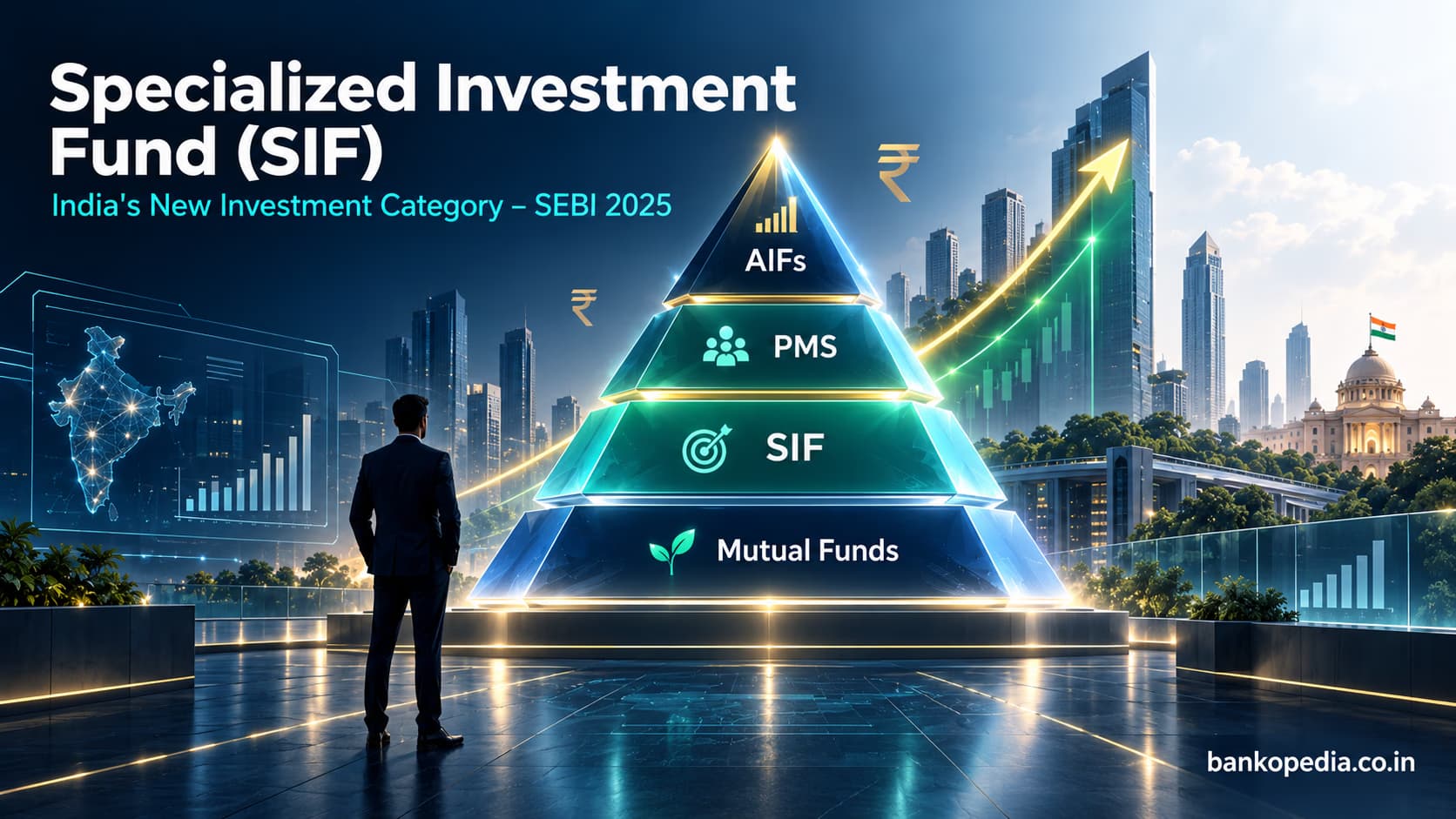
SIFs effectively sit between:
The main attraction is access to sophisticated investment strategies at a much lower entry level than PMS or AIFs.
SIF vs Mutual Fund: Key Differences
Feature | Mutual Fund | SIF |
|---|
Target investor | Retail/general investors | Experienced or sophisticated investors |
Minimum investment | Scheme dependent; usually low | ₹10 lakh threshold |
Strategy | Mostly conventional long-only | Long-short and specialised strategies |
Short exposure | Restricted | Permitted through derivatives within limits |
Complexity | Low to moderate | Moderate to high |
Derivative usage | Primarily within MF limits | Greater strategic flexibility |
Risk | Depends on scheme | Can be more complex/higher |
Regulation | SEBI | SEBI |
The key difference is investment flexibility.
A conventional equity mutual fund normally buys stocks expected to rise. A long-short SIF can also use derivatives to take positions that may benefit when selected securities decline.
Certain SIF strategies can maintain unhedged short exposure through derivatives of up to 25% of net assets.
How a Long-Short SIF Works
Suppose a fund manager believes:
A traditional mutual fund might buy banking stocks and simply avoid the technology stocks.
A long-short SIF could:
Go long banks + short selected technology stocks.
If banks rise while the targeted technology stocks fall, both positions could contribute positively.
But if technology stocks rise and banks fall, the portfolio can lose on both positions.
Therefore:
More flexibility does not mean guaranteed higher returns.
What is the ₹10 Lakh SIF Minimum Investment Rule?
For most investors, SEBI requires an aggregate investment of at least:
₹10 lakh
The threshold is calculated at the PAN level across SIF strategies offered by the same SIF/AMC, rather than requiring ₹10 lakh in every individual strategy.
For example:
The threshold would be satisfied.
Importantly, investments in ordinary mutual fund schemes of that AMC do not count toward the ₹10 lakh SIF requirement.
Accredited investors are exempt from the standard ₹10 lakh minimum threshold, subject to applicable rules.
SEBI has also been reviewing India's broader Accredited Investor framework. An August 2026 consultation proposed simplifying accreditation and expanding eligibility, which could eventually affect participation in sophisticated products including SIFs.
Can You Invest Through SIP or STP?
SIFs can offer facilities such as SIP, SWP and STP, but these remain subject to the minimum-investment requirement and individual strategy terms.
Investors should not assume that a small SIP allows them to bypass the ₹10 lakh threshold.
Also, switching between conventional mutual fund schemes and SIF investment strategies is generally not permitted under the current framework. Investors should check the Investment Strategy Information Document before investing.
What Types of SIF Strategies Are Allowed?
SEBI's framework permits seven broad strategies.
Equity
Debt
Hybrid
For example, an Equity Ex-Top-100 Long-Short Fund focuses substantially on companies outside India's 100 largest listed companies, potentially providing greater mid- and small-cap exposure.
A Sector Rotation Long-Short Fund can alter exposure between sectors as economic and market conditions change.
How Fast Are SIFs Growing?
The growth has been significant.
Period | Approx. SIF AUM |
|---|
March 2026 | ₹10,620 crore |
June 2026 | ₹17,858 crore |
July 2026 | ₹23,177 crore |
July AUM increased around 30% month-on-month, while inflows rose to approximately ₹4,922 crore. Hybrid long-short strategies dominated the market, accounting for roughly two-thirds of total SIF assets.
Despite this growth, SIFs remain tiny compared with India's overall mutual fund industry.
That makes SIFs an emerging niche rather than a replacement for mutual funds.
Latest SIF Updates in 2026
The SIF ecosystem continued expanding during August.
Aditya Birla Sun Life AMC, for example, launched two new equity long-short strategies under its APEX SIF platform in August 2026, showing that more major fund houses are entering the category.
Another important development came from SEBI.
On July 21, 2026, SEBI introduced a dedicated certification framework for SIF distributors. Professionals selling or distributing SIFs are required to hold the NISM Series V-D: Mutual Fund – Specialized Investment Fund Distributors Certification. This certification also permits distribution of conventional mutual funds.
This is important because SIFs are considerably more complex than conventional retail mutual funds, particularly because of derivatives and short positions.
SIF vs Mutual Fund vs PMS(Portfolio Management Services) vs AIF(Alternative Investment Fund)
Product | Typical Minimum | Complexity | Typical Investor |
|---|
Mutual Fund | Low | Low–Moderate | Retail |
SIF | ₹10 lakh* | Moderate–High | Experienced/affluent |
PMS | ₹50 lakh | High | HNI |
AIF | ₹1 crore** | Very High | HNI/institutional |
Accredited-investor exemptions can apply.
*Subject to regulatory/category exceptions.
SIF therefore fills an important gap between retail mutual funds and high-ticket alternative investments.
Major Risks of SIFs
Investors should pay particular attention to:
Market risk: Equity, debt and other securities can lose value.
Short-position risk: A short position loses money when the underlying security rises.
Derivative risk: Derivatives create additional complexity and exposure.
Strategy risk: Performance depends heavily on whether the manager's investment view is correct.
Concentration risk: Some SIF strategies can have significant exposure to specific sectors or market-cap segments.
Liquidity risk: Positions may become harder to exit during stressed markets.
Manager risk: SIF performance can depend more heavily on portfolio-manager skill.
Limited track record: India's SIF industry is still very young, so most strategies have not yet experienced multiple complete market cycles.
This last point is particularly important. A few months of strong returns are insufficient to determine whether a long-short strategy is consistently effective.
Can SIFs Perform Better During Falling Markets?
Potentially, but not necessarily.
Short positions may help offset losses in long positions.
For example:
Long portfolio: -8%
Profitable short positions: +4%
Approximate combined impact before other factors: -4%
But if both views are wrong:
Long portfolio: -8%
Short-position loss: -5%
Combined impact: -13%
A long-short strategy therefore does not provide capital protection.
Who Should Consider SIFs?
SIFs may suit investors who:
Already have a diversified investment portfolio
Can comfortably meet the investment threshold
Understand equity and derivative risks
Want exposure beyond conventional long-only funds
Have a suitable investment horizon
Can tolerate potentially higher volatility and complexity
For many investors, a sensible framework may be:
Core: diversified mutual funds
Satellite: specialized strategies such as SIFs
rather than replacing the entire mutual fund portfolio with SIFs.
Who Should Avoid SIFs?
SIFs may be unsuitable for:
First-time investors
Investors using emergency funds
Investors who do not understand derivatives
Investors with short investment horizons
Investors choosing funds purely because of recent returns
Traditional diversified mutual funds remain much simpler for most retail investors.
What Should You Check Before Investing?
Before choosing an SIF, examine:
As performance histories become longer, metrics such as Sharpe ratio, Sortino ratio and maximum drawdown should become increasingly useful for comparing strategies.
SIF or Mutual Fund: Which is Better?
Neither is automatically better.
Choose conventional mutual funds if simplicity, diversification, smaller investment amounts and long-term wealth creation are your priorities.
Consider SIFs if you already have a strong core portfolio and specifically want access to sophisticated strategies such as long-short investing or dynamic asset allocation.
For many experienced investors, the more useful question is therefore not:
“SIF or Mutual Fund?”
but:
“How much, if any, should SIFs contribute to my overall portfolio?”
Conclusion
Specialized Investment Funds are one of the most significant recent developments in India's asset-management industry.
With a ₹10 lakh entry threshold, greater derivative flexibility and strategies such as long-short investing, SIFs bridge part of the gap between conventional mutual funds and products such as PMS and AIFs.
Rapid growth to approximately ₹23,177 crore of AUM by July 2026 shows strong early investor interest. But the category remains young, and its strategies carry additional risks that should not be ignored.
For most retail investors, diversified mutual funds are likely to remain the core investment vehicle. For experienced investors who understand the risks, SIFs can potentially provide an additional source of diversification.
Disclaimer: This article is for educational and informational purposes only and does not constitute investment, tax or financial advice. Mutual funds and Specialized Investment Funds are subject to market risks. Investors should read the applicable investment-strategy documents and consider consulting a SEBI-registered investment adviser before investing.