How Housing Finance Companies Raise Capital in India
The Indian housing finance sector sits at a critical intersection of public policy, financial engineering, and retail credit delivery. As the government continues to push homeownership through schemes like Pradhan Mantri Awas Yojana (PMAY), the institutions that actually disburse home loans — particularly housing finance companies (HFCs) — face a perpetual challenge: matching long-tenure mortgage assets with equally stable and cost-effective liabilities. Understanding housing finance company capital raising in India is therefore not merely an academic exercise. It directly determines how much credit flows into the residential real estate market, at what cost, and on what terms ordinary borrowers can access it. This article breaks down the regulatory ecosystem governing HFCs, the instruments they use to fund themselves, the capital adequacy rules that constrain their choices, and the downstream consequences for home loan borrowers across the country.
What Are Housing Finance Companies and How Are They Regulated by NHB and RBI
A Housing Finance Company is a non-banking financial institution that is registered under the National Housing Bank (NHB) Act, 1987 and primarily engaged in the business of providing finance for the purchase, construction, repair, or renovation of residential properties. Unlike commercial banks, HFCs are specialised entities with a mandate centred on housing credit. Prominent examples include HDFC Ltd (now merged with HDFC Bank), LIC Housing Finance, PNB Housing Finance, Can Fin Homes, Bajaj Housing Finance, and Aavas Financiers, among others.
Historically, the National Housing Bank was the sole regulator of HFCs. However, a landmark regulatory shift occurred in 2019 when Parliament amended the NHB Act and transferred the primary regulatory authority over HFCs to the Reserve Bank of India (RBI). This transition was partly precipitated by the IL&FS crisis of 2018, which exposed significant governance and liquidity vulnerabilities across the broader NBFC-HFC ecosystem.
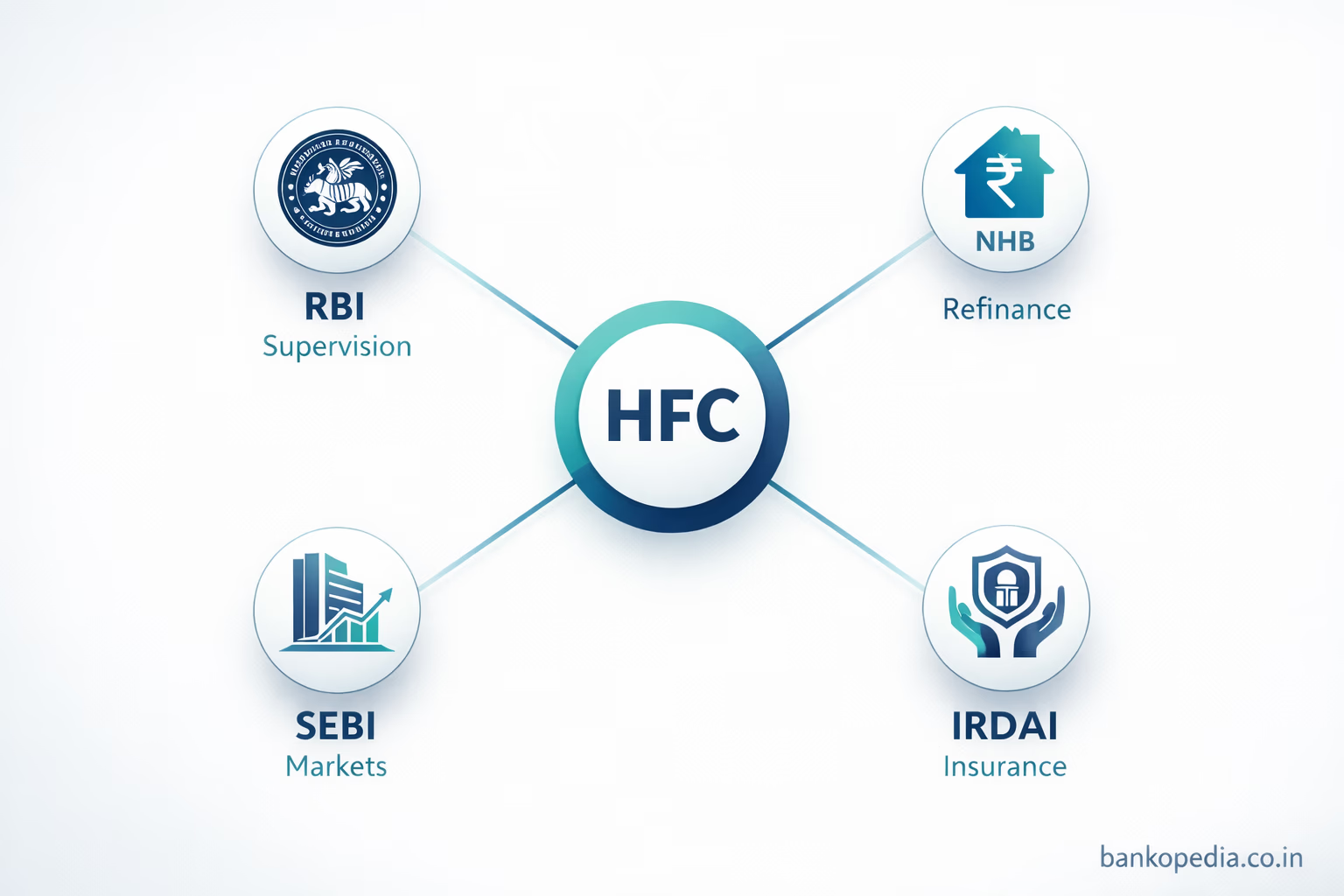
Today, the regulatory architecture for HFCs is as follows:
RBI exercises overarching prudential supervision, setting guidelines on capital adequacy, asset classification, provisioning norms, liquidity management, and corporate governance.
NHB continues to play a refinancing and developmental role, channelling concessional funds to HFCs for priority-sector and affordable housing lending.
SEBI regulates the capital market activities of HFCs — including public bond issuances, listing of Non-Convertible Debentures (NCDs), and equity market operations.
IRDAI becomes relevant when HFCs mobilise insurance-linked products or when their group entities are insurance companies.
For an entity to be classified as an HFC, it must ensure that at least 60% of its total assets are in the form of housing finance. Out of the total assets, not less than 50% must be by way of housing finance for individuals. These thresholds shape the entire business model and, by extension, the capital-raising strategy of every HFC operating in India.
Key Methods HFCs Use to Raise Capital: Equity, Debt, and Securitisation
The liability management of an HFC is a sophisticated exercise. Unlike a bank that can accept retail deposits at relatively low cost, HFCs have a more restricted and market-dependent funding toolkit. Here is a structured breakdown of the primary channels through which they raise capital:
1. Equity Capital
Equity forms the foundation of an HFC's balance sheet. It is raised through:
Initial Public Offerings (IPOs) and Follow-on Public Offers (FPOs): Listed HFCs access public equity markets for growth capital. Bajaj Housing Finance's ₹6,560 crore IPO in 2024, for instance, was one of the most subscribed financial sector offerings in recent memory.
Qualified Institutional Placements (QIPs): A faster route for listed HFCs to raise equity from institutional investors — domestic mutual funds, foreign portfolio investors (FPIs), insurance companies, and pension funds — without the time-consuming public offer process.
Private Equity and Strategic Investment: Smaller or unlisted HFCs often attract PE investors or strategic partners (including foreign entities) who bring both capital and governance improvements.
Rights Issues: Existing shareholders are offered additional shares at a discounted price, a method that is particularly favoured when management wants to avoid dilution to external parties.
Equity capital is expensive in the long run (given shareholder return expectations) but is non-interest-bearing and strengthens the HFC's net worth — the cornerstone metric for regulatory capital adequacy.
2. Debt Instruments
Debt is by far the dominant funding source for most HFCs. Given the long-tenor nature of home loans (often 15–30 years), HFCs ideally seek to match their liabilities with equally long-duration debt. In practice, however, a combination of short, medium, and long-term instruments is used:
Non-Convertible Debentures (NCDs): Both publicly listed and privately placed NCDs are a workhorse instrument for HFCs. Publicly listed NCDs allow retail participation and are regulated by SEBI under the SEBI (Issue and Listing of Non-Convertible Securities) Regulations, 2021.
Commercial Papers (CPs): Short-term instruments (typically up to 1 year) used for liquidity management. CPs are issued at a discount and are popular among treasury desks of mutual funds and corporates.
Bank Term Loans: Borrowings from scheduled commercial banks, often at a spread over the repo rate or MCLR. This is a significant and relatively stable funding line.
External Commercial Borrowings (ECBs): Larger, credit-rated HFCs access overseas debt markets — particularly out of Singapore, London, and New York — to diversify their liability base and benefit from lower global interest rates (though hedging costs can offset savings).
NHB Refinance: NHB provides concessional refinance to HFCs for lending to priority sectors, including Economically Weaker Sections (EWS) and Low Income Group (LIG) borrowers. This remains a unique and cost-effective funding line unavailable to most other financial institutions.
Public Deposits: Certain HFCs registered as deposit-taking entities are permitted by RBI to accept fixed deposits from the public. This provides a sticky, retail liability franchise, though it comes with stricter compliance and liquidity requirements.
Subordinated Debt and Perpetual Bonds: Issued to count as Tier II capital under regulatory frameworks, these instruments carry higher yields and are typically subscribed by institutional investors.
3. Securitisation and Mortgage-Backed Securities
Securitisation has emerged as one of the most strategically important capital-raising tools for HFCs in India. It involves the pooling of mortgage loans into a Special Purpose Vehicle (SPV) and the issuance of Pass-Through Certificates (PTCs) or Direct Assignments (DAs) to investors.
Direct Assignment (DA) is the most commonly used securitisation route in India, where a pool of loans is directly sold to a bank. Banks are motivated to buy these pools because they receive priority-sector lending (PSL) classification on qualifying mortgage pools, making this a mutually beneficial transaction.
Pass-Through Certificates (PTCs) involve a trust structure, with ratings assigned by SEBI-registered Credit Rating Agencies (CRAs) like CRISIL, ICRA, and CARE. Investors receive periodic cash flows as underlying borrowers repay their home loans.
The RBI's 2021 Master Direction on Securitisation of Standard Assets brought in a comprehensive framework that reinforced the Minimum Holding Period (MHP) requirement and the Minimum Retention Requirement (MRR), ensuring that HFCs retain a meaningful economic interest — and thus continue to have skin in the game — even after they sell down their loan books. For well-capitalised HFCs, securitisation achieves two objectives simultaneously: it frees up balance sheet capacity for new lending and provides immediate liquidity.
How Capital Adequacy Requirements Shape HFC Funding Strategies
Capital adequacy is the most binding regulatory constraint on an HFC's growth ambition. Under RBI's extant guidelines, HFCs are required to maintain a Capital to Risk-Weighted Assets Ratio (CRAR) of at least 15%, of which Tier I capital must constitute a minimum of 10%.
This has profound implications for how HFCs think about their balance sheet:
Growth requires equity dilution or earnings retention: Every additional ₹100 of home loans an HFC disburses requires it to hold approximately ₹15 worth of capital (given standard risk weights). An HFC that grows its book aggressively without corresponding equity raising will see its CRAR erode, triggering regulatory scrutiny and potentially restricting further lending.
Risk weights determine capital efficiency: RBI assigns different risk weights to different loan categories. Individual home loans with lower Loan-to-Value (LTV) ratios attract lower risk weights, making them relatively capital-efficient. Construction finance to builders, on the other hand, attracts higher risk weights, consuming more capital per rupee lent.
Leverage caps limit pure debt reliance: While HFCs can leverage their equity significantly through debt, the CRAR framework effectively caps this leverage. The more equity an HFC has, the more debt it can support — hence the importance of regular equity capital raises for fast-growing lenders.
Tier II capital instruments provide buffer room: Subordinated bonds and perpetual instruments that qualify as Tier II capital give HFCs additional headroom. However, RBI limits how much of total regulatory capital can consist of Tier II instruments, preventing excessive reliance on hybrid instruments that may not absorb losses as effectively as core equity.
"The capital adequacy framework is not just a compliance exercise — it is the fundamental grammar of how an HFC must structure its balance sheet. Getting it right is the difference between sustainable growth and a liquidity crisis."
The post-IL&FS regulatory tightening also introduced Asset Liability Management (ALM) guidelines that require HFCs to disclose and manage mismatches between the tenure of their assets and liabilities. Prolonged asset-liability mismatches — particularly funding long-term mortgages with short-term commercial paper — were at the heart of the NBFC liquidity crisis of 2018–19. Today, HFCs are required to submit granular ALM statements to RBI and maintain sufficient high-quality liquid assets (HQLA) to cover near-term outflows.
Larger HFCs classified as systemically important (with asset sizes above ₹500 crore) face additional reporting and governance requirements, including mandatory board-level Risk Management Committees and independent compliance functions.
Impact of HFC Fundraising on Home Loan Availability and Interest Rates
The capital structure of an HFC is not a back-office concern — it has direct, tangible consequences for the millions of Indian households seeking to buy a home. Here is how the fundraising dynamics play out for borrowers:
Cost of Funds Determines Loan Pricing
Unlike banks that price loans off the RBI repo rate (through the External Benchmark Linked Rate or EBLR system), HFCs have greater discretion in setting their Prime Lending Rates (PLRs). Their loan pricing is fundamentally anchored to their weighted average cost of borrowing. An HFC that successfully raises five-year NCDs at 7.5% per annum will be able to offer home loans more competitively than one forced to rely on expensive short-term bank lines at 9%.
When liquidity tightens in the debt market — as it did sharply after the IL&FS collapse and again during periods of global risk-off sentiment — HFCs face sharply higher borrowing costs, which are eventually passed on to borrowers through higher home loan rates, tightened eligibility criteria, or both.
Securitisation Activity Signals Credit Availability
A buoyant securitisation market is a reliable proxy for the health of home loan availability. When banks are eager to buy mortgage pools from HFCs (driven by PSL targets), HFCs can recycle capital faster, enabling them to lend more aggressively. Periods of low securitisation activity — as seen during the 2020 COVID-19 disruption — tend to correspond with constrained credit flows in the affordable housing segment.
Equity Raises Signal HFC Confidence
When a major HFC announces a large equity raise — whether through a QIP or a rights issue — it typically signals management's confidence in the growth pipeline. For borrowers, this is positive news: a well-capitalised HFC is more likely to compete aggressively on loan pricing and product innovation (flexible EMIs, step-up structures, top-up facilities) than one operating close to its regulatory capital floor.
NHB Refinance: The Affordable Housing Multiplier
For borrowers in the EWS and LIG categories — those most dependent on affordable housing finance — NHB's refinance window is a critical subsidy mechanism. HFCs that access NHB refinance at concessional rates (often 50–100 basis points below market rates) are able to pass on a meaningful cost benefit to borrowers in the ₹5–15 lakh loan ticket size range. This is the segment where HFCs like Aavas, Home First Finance, and Aptus Value Housing have carved a significant niche, and their ability to access NHB lines is a competitive differentiator.
Foreign Capital and the Cost-of-Funds Equation
As Singapore has emerged as the top FDI source for India in recent periods, the role of foreign capital — both equity and debt — in the HFC ecosystem deserves attention. Several large HFCs have issued USD-denominated bonds in international markets or attracted FPI investment into their rupee bonds. While this diversifies their liability base, it also introduces currency risk. HFCs typically use cross-currency swaps and forward contracts to hedge this exposure, adding a layer of cost that must be factored into overall funding economics.
Conclusion: Why Savvy Borrowers Should Watch HFC Balance Sheets
The journey from an HFC raising ₹1,000 crore through a bond issuance in Mumbai to a first-time homebuyer in Pune receiving a ₹40 lakh home loan is neither linear nor simple. It passes through a maze of regulatory requirements, market conditions, investor appetite, and internal credit assessments. Yet the connection is direct and powerful.
For Indian banking professionals and informed borrowers, the key takeaways are clear. First, HFCs that maintain strong CRAR ratios, diversified liability structures, and active securitisation programmes are better positioned to offer competitive and consistent home loan products. Second, regulatory oversight by RBI — supported by NHB's developmental mandate — has significantly improved the structural resilience of the HFC sector since the turbulence of 2018–19. Third, the evolution of instruments like mortgage-backed securities, green bonds for affordable housing, and ECBs is gradually deepening the funding toolkit available to HFCs, with long-term benefits for credit availability.
As India's urban population continues to grow and the aspiration for homeownership deepens across income segments, the ability of HFCs to raise capital efficiently, responsibly, and at scale will remain one of the most consequential dynamics in the country's financial system. Understanding this machinery — from NHB refinance lines to SEBI-regulated NCD listings — is essential for anyone serious about Indian housing finance.

