AT-1 Bonds in India Explained: What Every Investor and Depositor Must Know
In the landscape of Indian fixed-income investments, few instruments have generated as much controversy, regulatory attention, and investor confusion as Additional Tier-1 bonds — commonly known as AT-1 bonds. Understanding AT-1 bonds India explained in full detail is no longer optional for serious investors, financial intermediaries, or even informed bank depositors. These perpetual debt instruments sit at the intersection of banking regulation and capital markets, offering higher yields than conventional bonds while carrying risks that are fundamentally different in nature — and far more severe in consequence. From the landmark Yes Bank write-down of 2020 to the subsequent Supreme Court proceedings that continue to reverberate through regulatory corridors, AT-1 bonds have forced an entire generation of Indian investors to confront the fine print they previously ignored. With India's banking sector currently demonstrating remarkable resilience — credit growth projected at 11–13% for the first half of the calendar year — understanding how banks raise capital and what that means for instrument holders has never been more relevant.
What Are AT-1 Bonds and Why Do Indian Banks Issue Them?
AT-1 bonds, or Additional Tier-1 bonds, are a category of perpetual, unsecured debt instruments that banks issue to strengthen their capital base. The term "Additional Tier-1" is derived from the Basel III capital framework — the international regulatory accord developed by the Basel Committee on Banking Supervision — which classifies bank capital into distinct tiers based on loss-absorbing capacity and permanence.
Under Basel III, a bank's capital structure is divided into:
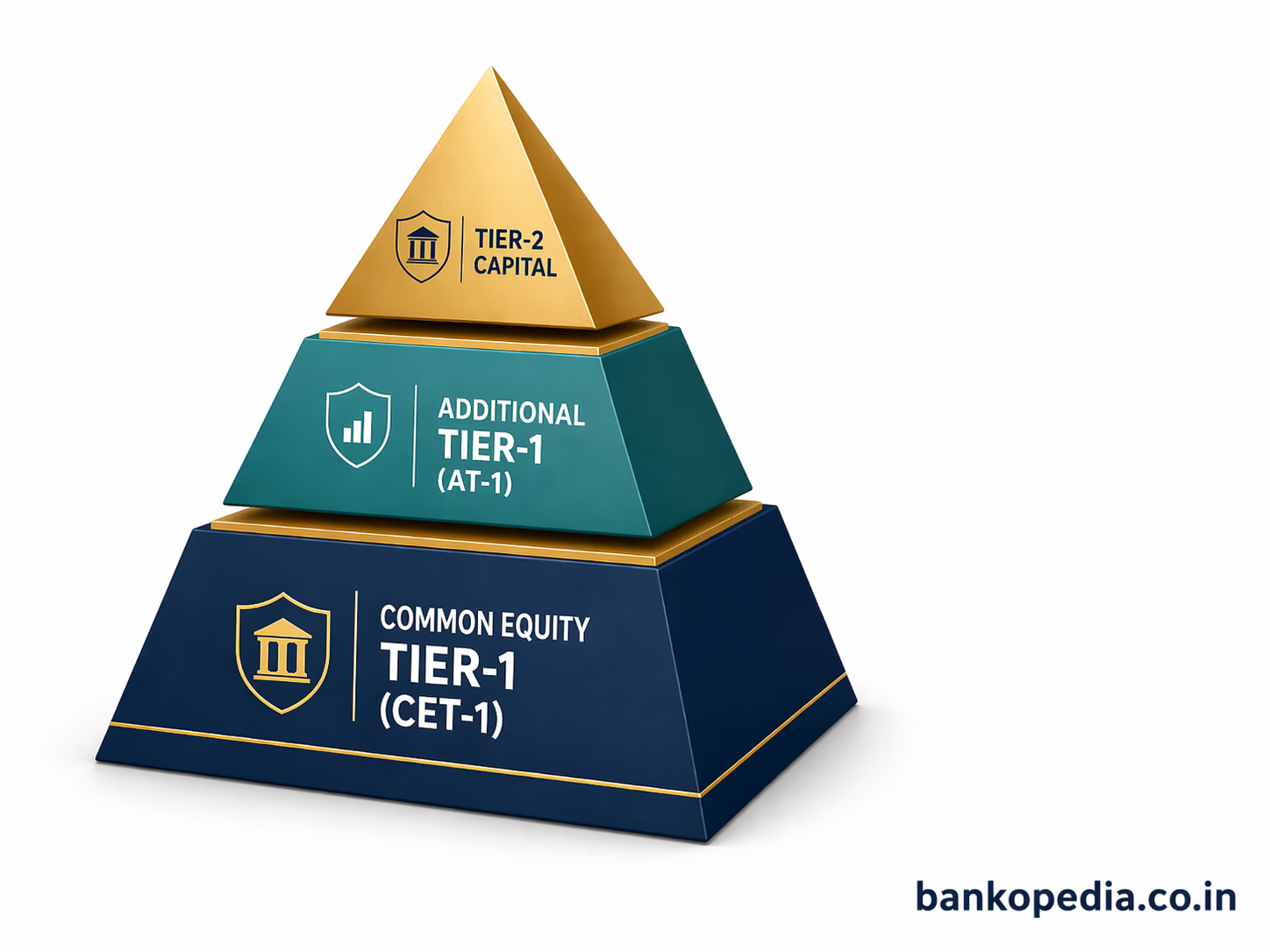
Common Equity Tier-1 (CET-1): The highest quality capital, comprising ordinary shares and retained earnings.
Additional Tier-1 (AT-1): Instruments that are subordinate to depositors and senior debt holders but absorb losses before equity in some structures. These include perpetual bonds with discretionary coupon payments.
Tier-2 Capital: Subordinated debt instruments with a minimum maturity, providing a secondary layer of loss absorption.
Indian banks issue AT-1 bonds primarily because they need to maintain regulatory capital ratios mandated by the Reserve Bank of India (RBI). As per RBI's Basel III guidelines, Indian banks must maintain a minimum Capital Adequacy Ratio (CAR) of 11.5%, which includes a Capital Conservation Buffer of 2.5%. AT-1 bonds help banks meet the Tier-1 capital requirement without diluting existing shareholders by issuing additional equity.
The economic logic for banks is straightforward: issuing AT-1 bonds is cheaper than raising equity, and the coupon payments are tax-deductible, unlike dividends on equity shares. For public sector banks in particular — which have historically operated under constraints on frequent equity issuances — AT-1 bonds have been a vital tool to shore up capital during periods of credit expansion or when non-performing assets (NPAs) erode retained earnings.
From the investor's perspective, AT-1 bonds have historically been marketed as a premium income product, offering yields 150–300 basis points above comparable government securities. Mutual funds, insurance companies, high-net-worth individuals (HNIs), and in some cases retail investors through fund-of-fund structures have all been participants in this market. The yields are attractive precisely because the risks embedded in these instruments are substantial — a reality that the market learned painfully in 2020.
How AT-1 Bonds Differ From Regular Bonds and Fixed Deposits
This distinction is critical, and it is precisely where many retail and semi-institutional investors have historically been misled or under-informed. The differences between AT-1 bonds, conventional bonds, and bank fixed deposits are not merely technical — they are existential from a risk perspective.
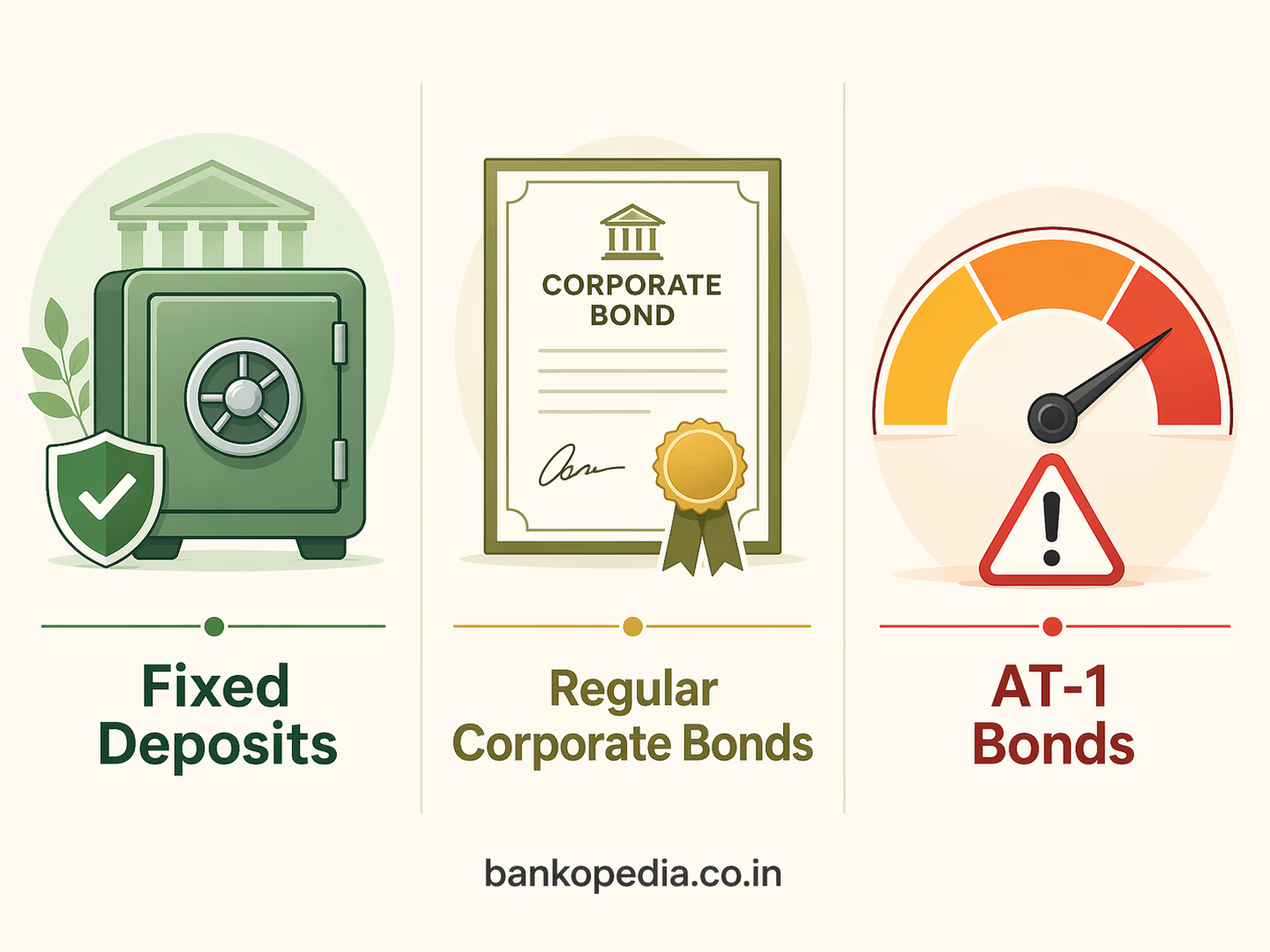
Maturity Profile
A standard corporate bond or government security has a defined maturity date — five years, ten years, or any contractually agreed period. At maturity, the principal is returned to the bondholder. Bank fixed deposits similarly have a fixed tenure and an assured return of principal at the end of the term.
AT-1 bonds, by contrast, are perpetual in nature. They have no fixed maturity date. Banks typically include a "call option" — the right, but not the obligation, to redeem the bonds after a specified period (usually five or ten years). If the bank chooses not to exercise this call option, the bond continues in perpetuity. Investors cannot demand repayment; they can only sell the instrument in the secondary market, where liquidity can be severely limited.
Coupon Payments
Interest payments on fixed deposits and regular bonds are contractual obligations. Missing them constitutes a default with legal consequences. AT-1 bond coupons, however, are discretionary. The issuing bank can skip coupon payments entirely if it does not have sufficient distributable reserves, or if paying the coupon would cause the bank to breach its regulatory capital requirements — and this skipping does not legally constitute a default. This is a profound structural difference that many investors did not appreciate until it was too late.
Loss Absorption Mechanisms
Fixed deposits are protected up to ₹5 lakh per depositor per bank under the Deposit Insurance and Credit Guarantee Corporation (DICGC) scheme. Senior bonds have a priority claim in the event of insolvency. AT-1 bonds sit at the bottom of the creditor hierarchy — ahead of equity shareholders, but below depositors, senior bondholders, and most other creditors. More critically, AT-1 bonds contain write-down or conversion clauses: if a bank's CET-1 ratio falls below a specified trigger level, the AT-1 bonds can be written down to zero or converted into equity, wiping out the bondholders entirely — even if the bank has not been formally declared insolvent.
Regulatory Oversight
Fixed deposits are regulated by the RBI under the Banking Regulation Act, 1949. Listed bonds fall under SEBI's regulatory ambit. AT-1 bonds occupy a unique dual regulatory space — they are issued under RBI's capital adequacy guidelines but are also subject to SEBI's disclosure norms when listed. This dual oversight has occasionally created ambiguity in investor protection frameworks, a gap that regulators have worked to address in recent years.
RBI Regulations Governing AT-1 Bonds in India
The regulatory architecture for AT-1 bonds in India is anchored in the RBI's Basel III Capital Regulations, which have been progressively tightened since their introduction in 2013. Understanding the regulatory framework is essential for any participant in this market.
Eligibility Criteria for AT-1 Issuances
The RBI has specified detailed criteria that an instrument must meet to qualify as AT-1 capital. Key among these are:
The instrument must be perpetual — no fixed maturity date and no investor put options.
Coupon payments must be non-cumulative and fully discretionary, with the bank having the unconditional right to cancel distributions.
The instrument must have loss absorbency features — either a write-down mechanism or a conversion into common equity when the CET-1 ratio falls below 6.125%.
The instrument must be subordinated to depositors, general creditors, and Tier-2 capital holders in liquidation.
The bank must not create an expectation at issuance that the instrument will be redeemed.
SEBI's Intervention on Valuation and Disclosure
Following the Yes Bank crisis, SEBI stepped in with significant regulatory changes in March 2021, issuing a circular that revised the valuation norms for AT-1 bonds held by mutual funds. SEBI initially proposed treating AT-1 bonds as having a 100-year residual maturity for valuation purposes — a move that would have dramatically marked down the Net Asset Values (NAVs) of debt funds holding such instruments. After considerable industry pushback, SEBI moderated this stance, ultimately arriving at a graduated maturity treatment framework.
SEBI also tightened disclosure requirements, mandating that offer documents for any fund investing in AT-1 bonds explicitly communicate the unique risks — particularly the perpetual nature, discretionary coupons, and write-down risk. Retail investors in mutual funds that hold AT-1 bonds must now be clearly informed of these exposures.
RBI Guidelines on Minimum Investment and Distribution
To limit retail investor exposure, the RBI and SEBI have imposed restrictions on who can invest directly in AT-1 bonds. Direct investments by retail investors are generally discouraged, with minimum investment thresholds set at levels that restrict access to institutional players and sophisticated HNIs. However, indirect exposure through debt mutual funds — particularly credit risk funds and banking and PSU debt funds — remains a channel through which retail investors can unknowingly hold AT-1 bond exposure, making fund-level disclosure all the more critical.
Ongoing Supervisory Expectations
The RBI's supervisory stance on AT-1 bonds has evolved considerably post-2020. Banks are now expected to ensure robust investor suitability assessments and transparent marketing. The RBI's annual Banking Regulation and Supervision reports have repeatedly emphasised that AT-1 instruments must not be marketed as quasi-fixed-deposit products, and bank staff involved in distributing these instruments must be adequately trained to convey the risk profile accurately.
"The key principle underlying Additional Tier-1 capital instruments is that they must genuinely absorb losses before depositors and senior creditors are affected. This is not a theoretical provision — it is a live regulatory tool." — RBI Master Circular on Basel III Capital Regulations
Key Risks of AT-1 Bonds: Lessons From the Yes Bank Case
No discussion of AT-1 bonds in India is complete without an in-depth examination of what happened at Yes Bank in March 2020 — arguably the most significant stress event in the Indian banking capital markets since economic liberalisation.
The Yes Bank AT-1 Write-Down: What Happened
In early March 2020, the RBI placed Yes Bank — which had been battling a severe NPA crisis and a deteriorating capital position — under a moratorium and subsequently announced a reconstruction scheme. A critical element of this scheme was the complete write-down of Yes Bank's outstanding AT-1 bonds, amounting to approximately ₹8,415 crore. Bondholders — including institutional investors, mutual funds, and in some cases individuals who had invested through private banking channels — saw their investments reduced to zero almost overnight.
The write-down was legally grounded in the contractual terms of the AT-1 bonds, which explicitly provided for this outcome. However, many investors — particularly those sold these bonds by bank relationship managers as "safe, high-yield alternatives to fixed deposits" — were shocked. The episode exposed the systemic mis-selling that had characterised the distribution of AT-1 bonds in the Indian market.
The Supreme Court Proceedings
The Yes Bank AT-1 write-down subsequently became the subject of extensive litigation, with aggrieved bondholders approaching various forums including the Bombay High Court and ultimately the Supreme Court of India. The legal challenge centred on whether the write-down was procedurally valid and whether the RBI had followed due process in invoking the loss-absorption clause. Yes Bank, in recent public disclosures, has stated that it does not expect any material financial impact from the Supreme Court's ruling on the AT-1 matter — a statement that provides some regulatory certainty but offers little comfort to the original investors who suffered losses.
The legal proceedings have nonetheless served an important systemic function: they have forced regulators, banks, and courts to articulate the precise legal framework within which AT-1 write-downs can occur, which provides greater predictability for future market participants.
The Broader Risk Taxonomy
The Yes Bank episode crystallised several risk categories that all AT-1 investors must internalise:
Write-down Risk: The principal can be written down to zero if the bank's CET-1 ratio falls below the trigger level or if the RBI determines that write-down is necessary for the bank's viability.
Coupon Skip Risk: Interest can be withheld without legal consequence if the bank lacks distributable reserves or faces regulatory restrictions.
Extension Risk: If the bank does not exercise its call option, investors remain locked in perpetually, with no recourse to demand principal repayment.
Liquidity Risk: The secondary market for AT-1 bonds in India remains thin. In periods of stress, finding a buyer at a reasonable price can be extremely difficult, forcing mark-to-market losses even if the bond is not written down.
Regulatory Risk: The regulatory environment governing AT-1 bonds is evolving rapidly. Changes in valuation norms, disclosure requirements, or capital adequacy rules can significantly impact the value and marketability of AT-1 bonds.
Mis-selling Risk: Given the complex nature of these instruments, there is a material risk that AT-1 bonds are sold to investors who do not fully understand what they are purchasing.
Lessons for the Mutual Fund Investor
Retail investors who hold debt mutual funds — particularly banking and PSU debt funds, credit risk funds, or certain hybrid funds — may have indirect exposure to AT-1 bonds without being fully aware of it. Post the SEBI regulatory changes, fund factsheets are required to clearly disclose AT-1 bond exposure. Investors in these funds should periodically review their fund's portfolio disclosures and ensure they are comfortable with the embedded risk profile.
A Practical Guide: Should You Consider AT-1 Bonds?
For institutional investors and sophisticated HNIs who fully understand the risk-return trade-off, AT-1 bonds can play a role in a diversified fixed-income portfolio — particularly when issued by well-capitalised public sector banks with strong regulatory oversight. The yield premium is real, and for an investor who can absorb the tail risk, it may be justified.
However, for the vast majority of individual investors — including those who have historically used bank fixed deposits or investment-grade bonds as the backbone of their fixed-income allocation — AT-1 bonds represent a categorically different type of instrument. The higher yield is not compensation for credit risk alone; it is compensation for a suite of structural features that fundamentally alter the risk profile compared to any conventional debt instrument.
Key questions every investor should ask before considering direct or indirect AT-1 bond exposure:
Do I fully understand that my principal can be written down to zero even if the bank continues to operate?
Am I comfortable receiving no interest in a given year without any legal remedy?
Is my investment horizon genuinely long-term, given the perpetual nature and limited liquidity of these instruments?
Have I assessed the capital adequacy position and asset quality of the issuing bank independently?
Have I reviewed the specific terms of the AT-1 prospectus, particularly the write-down trigger levels?
India's banking sector is demonstrating encouraging resilience, with projected credit growth of 11–13% indicating a productive deployment environment for bank capital. This macro tailwind may support the capital positions of issuing banks, reducing near-term write-down risk. But structural risks embedded in AT-1 instruments are not cyclical — they are permanent features of the instrument design, and they remain fully operative regardless of the macroeconomic environment.
For depositors who simply want safe, predictable returns, the ₹5 lakh DICGC insurance cover on bank fixed deposits remains an unambiguous protection that AT-1 bonds categorically cannot provide. In a market where the temptation of higher yields is always present, understanding what you are giving up — and what new risks you are accepting — is the foundation of sound financial decision-making. On that score, the story of AT-1 bonds in India offers both a cautionary tale and a rigorous lesson in the anatomy of banking capital.

